


Are developers well covered?
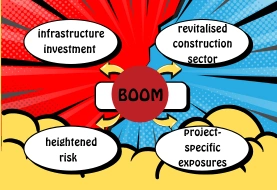
South Africa is entering an ambitious new phase of infrastructure investment, with the government pledging R1 trillion for development over the next three years, and President Cyril Ramaphosa calling on the private sector to quadruple that figure to R4 trillion. While this new infrastructure push is reinvigorating the construction sector, it also poses increased risks for contractors and developers who may be underestimating the scale and complexity of project-specific risks.
This is according to Mpho Rakometsi, claims specialist at Santam Specialist Solutions, who says the biggest threats to infrastructure delivery are not necessarily physical hazards, but systemic weaknesses that tend to go unaddressed. “Deliveries are often delayed due to poor project preparation, unclear responsibilities in joint ventures, payment delays and supply chain disruptions, while regulatory and environmental approvals are overlooked, creating further risks,” he explains.
Engineering design flaws are also a major problem, often leading to costly rework and delays. “Design errors and omissions are a common cause of professional liability claims,” Racomezzi says. “In South Africa, these risks are further exacerbated by criminal interference, including corruption, site robbery and construction mafias, causing disruption, rising costs and reputational damage.”
The hidden costs of underinsurance and secrecy
Even when projects are well managed, under-insurance/non-disclosure remains a major pitfall and can significantly reduce insurance payouts. Racometsi recalls instances where contractors did not disclose the actual contract amount at the contracting stage. This means that the Contractor All Risk (CAR) policy does not cover damages related to that particular contract. “When a major storm caused structural damage, the insured did not disclose the actual value of the contract, a value that exceeded the annual contract limit. This non-disclosure exposed the contractor/insured and found it denied, leaving them to bear the full cost of the damage associated with the project,” he explains.
“This example highlights how not insuring in full or at appropriate limits can jeopardize the financial viability of a project,” he says.
Mr Racometsi emphasizes that CAR and PI policies remain the basis for risk transfer in the construction sector. “CAR policies protect against physical damage to works during construction, while PI policies address errors in design or professional services,” he says. “However, CAR and PI alone are not enough; a broader liability policy is equally important to address third-party claims that fall outside the scope of CAR.”
Bridge the gap with single project responsibility
For large-scale developments and joint ventures, single project liability (SPL) policies have emerged as an important solution to the coverage gaps created by annual liability policies, PI policies, and CAR policies. “SPL rings-fences limits dedicated to one project and avoids dilution across multiple sites,” explains Rakometsi. “This is particularly useful in joint ventures as SPL unifies coverage for all parties under one policy and eliminates disputes over who has annual coverage. Importantly, this also applies to completed operations, ensuring liability protection is maintained against defects and claims that arise after handover.”
He cited cases where defects in completed work were discovered several years after handover. “Single-project liability policies were in place, with dedicated aggregate limits tied to that particular project, ensuring that claims were fully covered. If the contractor had relied solely on annual liability policies, PI, and CAR policies, the available limits would have been eroded by unrelated claims, leaving the project unfunded.”
Scale according to capacity
To meet the demands of this growing market, Santam Specialist Solutions offers underwriting capacity of up to R350,000,000.00, depending on underwriting criteria and market conditions. “This means we can commit to very large limits on a single risk, giving contractors and project owners confidence that their insurer will cover significant claims,” Racomezzi explains. “In practice, this ability is typically available on an occurrence-by-occurrence basis for public liability and, subject to policy terms, on an annual aggregate basis for professional indemnity.”
He says such high levels of coverage are best suited for megaprojects such as large transportation routes, power generation facilities, dams or major public-private partnerships where both the complexity and potential liability are significant.
Prepare for the coming wave
As South Africa’s infrastructure boom gains momentum, Racometsi urges contractors and project managers to balance ambition with caution. “Three things need to be prioritized: sound risk management, robust insurance, and strong governance,” he says. “Careful planning of budgets, schedules and supply chains is essential to limit delays and overruns. Similarly, securing appropriate coverage, from CAR and PI to liability and SPL, can protect projects from costly setbacks.”
That means “preparedness and protection will be as important as technical execution,” he concludes.
This media release provides general information only and does not constitute financial advice. Customers should consult a licensed advisor for advice regarding their specific needs.
