


As artificial intelligence reshapes the global economy, Africa’s AI future is becoming a test case for whether ambition and investment match, or whether it will be met by default.
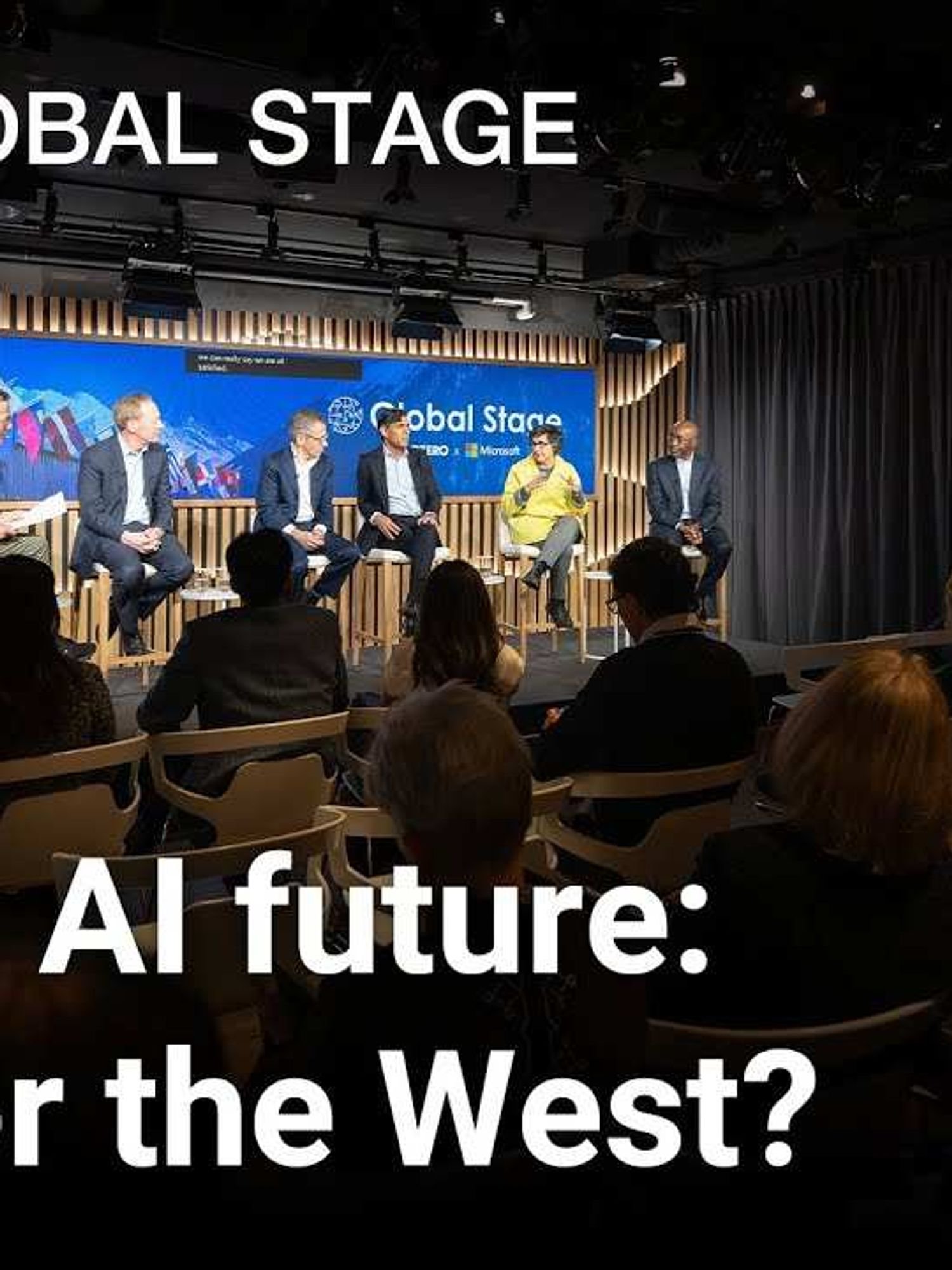
An all-star panel issued a blunt warning during the 2026 World Economic Forum’s GZERO Media Global Stage livestream in Davos. Without serious capital, the next phase of Africa’s AI infrastructure will follow the same path as previous China-led telecom booms.
“Let’s stop treating AI as a silver bullet that will solve everything,” said Strive Masiyiwa, Founder and Executive Chairman of Cassava Technologies. The real challenge, he argued, is not technology. It’s an investment. And if Western governments and institutions balk, we shouldn’t be surprised by the outcome. “People shouldn’t complain when China makes investments,” Masiyiwa said. “If you don’t invest, Africa will look where it can get that investment.”
Microsoft vice chairman and president Brad Smith agreed, explaining what could change the equation. He said African governments can help stimulate private capital by creating demand themselves. “The more the public sector moves to the cloud and leverages AI, the more it creates demand that fuels more free market investment,” Smith explained.
Scale matters. Rather than piecemeal national efforts, Smith argued that aggregating demand across the region, such as building a data center in Kenya to serve multiple countries in East Africa, could free up the capital and energy needed to power AI at scale. Without that adjustment, market failure will determine the outcome, he warned. “So at the end of the day, capital is going to flow out of China,” Smith said, explaining Belt and Road-style expansion into AI infrastructure, chips and data.
The panel widened the lens further. Ian Bremer, president and founder of Eurasia Group and GZERO Media, noted that China is already investing across the ecosystem, including universities, energy and infrastructure, and is well positioned to secure long-term advantages. Former British Prime Minister Rishi Sunak added that widespread adoption of AI was already occurring through cheap open source models, raising urgent questions about what alternatives Western countries could offer to countries unable to provide their own systems.
And the consequences of inaction extend far beyond AI. Arancha González Laya, dean of the Paris School of International Relations, cited access to electricity as a fundamental example. European governments, development banks, foundations and the private sector are already coming together to bring electricity to hundreds of millions of people in sub-Saharan Africa. “Where is the United States in this situation?” she asked. “Nature has a fear of emptiness. If you leave an empty space alone, someone will fill it.”
A message from Davos: Africa’s AI future will not be predetermined by technology, but by who shows up, who invests, and who builds the infrastructure first.
This clip is excerpted from the GZERO Media Global Stage panel discussion recorded at the 2026 World Economic Forum. To watch the entire conversation, visit gzeromedia.com/globalstage.
The Global Stage series, presented by GZERO Media in partnership with Microsoft, convenes leaders from government, business, and civil society in key international forums to examine critical issues at the intersection of technology, politics, and society, and explore how global cooperation can provide solutions in an era of accelerated change.
