


For many digital products in Africa and its diaspora, failure is not self-evident. No error messages or angry emails. Users simply disengage. The form will remain incomplete. Instructions will be ignored. Trust disappears silently.
This quiet gap is at the heart of NKENNEAi. NKENNEAi is an African language AI company building translation infrastructure for environments where accuracy and reliability are as important as speed.
NKENNEAi was born out of NKENNE, a consumer language learning platform created to address the lack of presence of African languages in mainstream digital tools. When NKENNE started, only three languages were supported. The shape of the product quickly changed depending on demand.
As the implementation progressed, the team began to notice recurring patterns. While individuals were eager to learn their language, institutions serving the same communities struggled to communicate with them clearly and accurately.
Language learning solved one problem. Infrastructure remained lacking.
From learning to infrastructure
Most of the global translation tools were not designed around African languages. Many translators struggle with tonal meaning, regional differences, and cultural context, creating translations that are easy to read but are actually unreliable.
This limitation becomes important in fields where miscommunication has consequences.
“What we kept seeing was that users weren’t completely rejecting the product, but were quietly moving away from it,” said Ngozi Iwuchukwu, vice president of curriculum at NKENNE. “In fields like healthcare, government, and financial services, misspoken words don’t cause complaints; they cause a loss of trust. NKENNEAi was built to address that gap before it becomes a reality.”
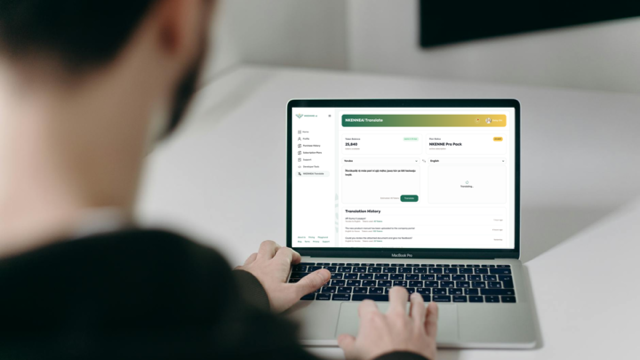
NKENNEAi positions itself not as a general-purpose translation tool, but as a language infrastructure for high-impact environments. Its AI models are built specifically for African languages, prioritizing tonal accuracy and contextual meaning to help organizations communicate clearly with the people they serve.
Early deployment in highly reliable environments
This focus is driving adoption among organizations operating in sensitive, high-stakes situations.
Nonprofit organizations like Women In Need, which operates in both the United States and Nigeria, use NKENNEAi to translate their websites and resources into African languages. For the communities we serve, accurate language access directly impacts whether our services are understood and used.
Similar needs are emerging in government, healthcare, telecommunications, NGOs, and financial institutions, where even small translation mistakes can silently undermine engagement, compliance, and trust.
Institutional recognition and support
NKENNEAi has evolved from a consumer learning platform to an enterprise-grade language infrastructure, gaining attention from leading educational institutions.
Following NKENNE’s success, the company has received the following support and recognition:
Bosun Tijani, Nigeria Minister of Communications, Innovation and Digital Economy National Science Foundation, commercialization support through competitive SBIR funding Advisory support from Google, including formal recommendations during NKENNEAi’s National Science Foundation SBIR review process
This support reflects a growing understanding that African languages are not cutting-edge examples of global technology. These are core to serving hundreds of millions of users.
shape the conversation
Alongside its technology, NKENNEAi runs NKENNEAi Talks, a monthly public series focused on advancing African languages into the modern digital age. This session brings together engineers, linguists, policymakers, and builders to discuss language equity, AI ethics, and the future of multilingual systems.
For many in the ecosystem, this series has become a regular checkpoint to see how African languages are represented, or ignored, in modern digital products.
what happens next
Over the next month, NKENNEAi will expand both its language coverage and product capabilities, moving deeper into a full-stack language infrastructure.
The platform adds Igbo, Somali and Hausa to its language suite, significantly expanding access to some of the most widely spoken African languages across Africa and the diaspora.
In parallel, NKENNEAi is introducing a Grammarly-style autocorrection layer designed specifically for African languages. This feature helps users and educational institutions spot tone, grammar, and contextual errors before they reach end users. This is an important step for trust-based communication.
The company is also rolling out Speech-to-Text and Text-to-Speech capabilities, enabling organizations to go beyond written translation and support voice communications across digital and real-world environments.
These additions mark a shift from translation as a function to language as infrastructure.
quiet advantage
As Africa’s technology ecosystem expands, multilingual support is no longer an option. The current challenge is implementation. It’s about how accurately the system communicates and whether users can trust what they read or hear.
NKENNEAi is at that intersection, building tools that don’t just translate text, but enable organizations to communicate clearly in African languages.
In a market where trust determines adoption, the difference may not be huge, but it is decisive.
