


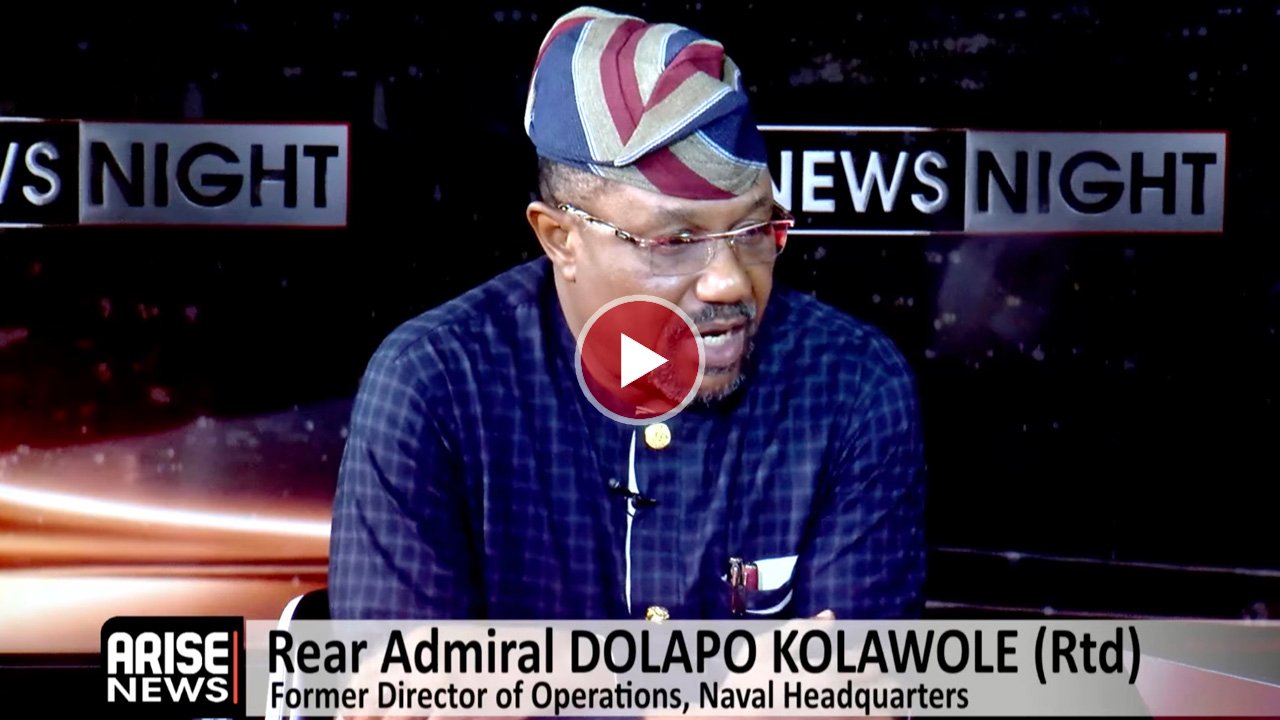
Former Chief of Naval Operations, Rear Admiral Dolapo Kolawole (retd), has said that Nigeria’s persistent insecurity and recent mass killings are primarily caused by intelligence failures rather than military incapacity, insisting that improved human intelligence and infiltration of terrorist networks are essential to ending the violence.
Kolawole said this in an interview with ARISE News on Wednesday, while reacting to the confirmation of the deployment of a small US military team to Nigeria and the resurgence of deadly attacks in various parts of the country, including the killing of security personnel and civilians in Benue State and mass casualties reported in Kwara State.
He began by praising Nigeria’s military, especially its navy, after the country was rated as the strongest in Africa.
“First of all, I would like to congratulate the Federal Government, the Nigerian people and the Nigerian Armed Forces on the current global strength assessment that the Nigerian Navy is the strongest in Africa,” Kolawole said.
He attributed this ranking to the size of Nigeria’s naval assets.
“This is according to the number of platforms that the Nigerian Navy has today, which currently exceeds the 152 platforms of all other navies in Africa. In terms of quantity, it also exceeds the Arab Navy and the South African Navy,” he said.
According to him, the size and composition of the fleet is compatible with Nigeria’s security needs and regional responsibilities.
“Our current fleet is very well suited to Nigeria’s threat perception and our global ambitions, regional ambitions so to speak, and responsibilities,” Kolawole said.
Citing the resurgence of terrorist attacks and mass killings, he said the Nigerian Navy possesses special capabilities that can be deployed in asymmetric warfare.
“To specifically answer your question, yes, the Nigerian Navy has a component that can be used, deployed and function for asymmetric warfare, and this is the Nigerian Navy Special Boat Service, which is a special forces unit of the Nigerian Navy,” he said.
Kolawole, who once commanded the unit, explained that the unit was designed for complex counter-terrorism operations.
“It’s modeled after the U.S. Navy SEALs. Service members and sailors are trained for asymmetric warfare on land and at sea, on land and at sea. They can function in either environment,” he said.
He added that the force could be used in targeted operations against terrorist organizations.
“This component of the Nigerian Navy fleet, the SBS Special Boat Service, its special warfare wing, can be deployed for operations similar to what just happened, including surgical strikes, decapitation of terrorist camps, targeting, prevention and protection of terrorists,” he said.
However, Kolawole stressed that military equipment alone cannot stop the killings and argued that the digital divide remains the biggest challenge.
“Let me divide. The fleet is floating. Now we are discussing the issue of asymmetric warfare on land,” he said.
“When we talk about these issues on the ground, on terrorism, on combat, the most important element is intelligence. To punch someone in the face, you have to see the face. When I don’t have the prerequisite intelligence to know who is where and what their intentions are, they will be able to take the lead,” he explained.
Kolawole said terrorists were taking advantage of weaknesses in intelligence agencies to carry out attacks at will.
“They can operate where they want, how they want, when they want, without my knowledge. So my first basic recommendation is that we develop and improve our intelligence capabilities,” he said.
He called for using human intelligence to penetrate deeper into terrorist groups.
“For groups like this, the basic solution is to have human intelligence, mole infiltration, intelligence agencies (DSS, Military Intelligence, Defense Intelligence Agency) infiltrate these organizations to find out who they are, their plans, where they operate from, their logistics bases and what they are trying to do,” Kolawole said.
“If I’m one step ahead of you in intelligence, I can stop you. I can stop you where you want to operate. I can cut your center of gravity, cut off your logistics, remove your leaders, and stop your operations,” he added.
On maritime security, Kolawole rejected claims that piracy, oil theft and militancy negate the navy’s high global standing.
“The problems of piracy, militancy and oil theft have decreased significantly. They still exist, but there will always be room for improvement,” he said.
“Even with the most capable military and police forces, it is difficult to maintain a completely crime-free environment,” he added.
He said improvements in naval capabilities had brought tangible results.
“If we look at the increasing capabilities of the Nigerian Navy, we see that these crimes are decreasing because of the availability of additional platforms and capital and capabilities, which is manifesting as an increase in maritime security,” Kolawole said.
Mr. Kolawole described Nigeria’s use of private maritime security companies, saying it was a homegrown and collaborative approach.
“Every country develops its own capabilities to suit its unique environment,” he said.
“What we have in Nigeria is a tripod: the government, the Nigerian Navy and the communities, the local people. The oil resources come from these communities and they are working with the Nigerian Navy to protect what is under their feet,” he explained.
He said the arrangement reduced friction between security forces and host communities.
“This has to some extent eliminated the constant conflicts and clashes between the Nigerian Navy and the communities currently involved in the security architecture, especially extremist groups,” Kolawole said.
He called on private security companies to work more closely with the navy.
“These private maritime security companies need to embrace the Nigerian Navy and see it as a partner rather than a rival,” he said, adding that the rivalry was creating “constant tension” and “better cooperative efforts are needed.”
Regarding the confirmation of the US military presence in Nigeria, Kolawole said this development signals deepening military cooperation, but requires a clear explanation from the Nigerian authorities.
“Basic strategic military logic dictates that if we are going to cooperate with the United States, there will be a joint operations center or joint cell where Nigerian military personnel will integrate with the U.S. cell for information sharing, coordination and operational execution,” he said.
He said Nigerians were entitled to transparency regarding the deployment.
“Now that we have heard that there are U.S. military personnel on the ground, the next step is for the Secretary of Defense and AFRICOM to shed more light on the composition, strength, purpose and mission of that group,” Kolawole said.
“We will wait until they have elaborated on the composition, strength, purpose and mission of this small group,” he added.
Kolawole said an official clarification was imminent, citing concerns that the disclosure may have come first from the United States rather than Nigerian authorities.
“I believe the Nigerian authorities will speak out. The defense minister will shed more light soon,” he said.
Bolwatife Enome
follow me:
