


Levent Kenneth/Stockholm
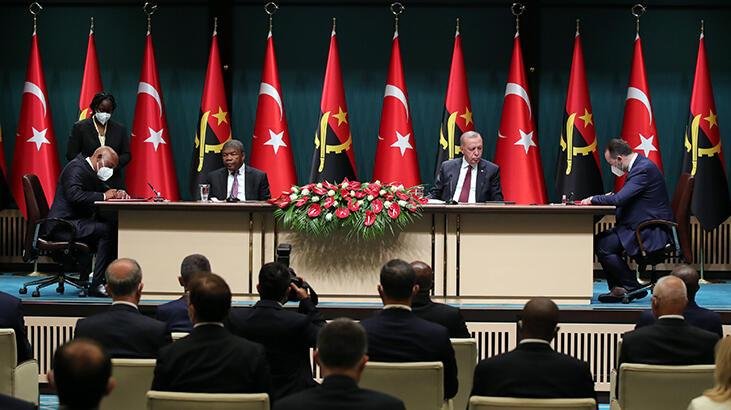
Turkish President Recep Tayyip Erdoğan welcomed Angolan President Joao Manuel Gonçalves Lorenzo in Ankara on Tuesday, marking the first official visit in the history of the two countries. Although commercial issues were expected to be at the top of the agenda, Turkey’s efforts related to defense exports dominated the visit.
The Turkish Presidential Directorate of Public Relations announced that a joint press conference titled “Turkey supports Angola in the fight against terrorism” will be held after the meeting between President Lorenzo and President Erdoğan, even though there have been no serious terrorist acts in Angola since 2010.
“We know and are watching, albeit from afar, what difficulties are occurring in Angola and in Africa. As a country that has always and everywhere proven itself in the fight against terrorism, Turkey also supports Angola,” Erdoğan said.
A day later, President Erdoğan’s true intentions became clear. Mr. Lorenzo, former Minister of Defense of Angola, visited the Presidential Palace of Defense Industry in Turkey together with Chairman Ismail Demir and Minister of Technology Mustafa Varank. During his short presentation, Mr. Lorenzo was introduced to the weapons produced by Türkiye. A video was released after the visit, but it was not made clear which weapons were presented to the visiting president.
Interestingly, President Erdoğan promised to visit Angola with a group of businessmen immediately after the United Nations General Assembly in September to address several issues there, including the defense industry. The two leaders will meet for the second time in just two months, suggesting that negotiations are underway on concrete projects.
As a side note, President Erdoğan, an Islamist who frequently claims to be defending the rights of all Muslims around the world, did not mention the rights violations suffered by Muslims in Angola during the meeting. According to the U.S. Department of State’s 2020 Report on International Religious Freedom, the Angolan government continued to neither recognize Muslim groups nor grant them permission to legally practice their religion. Applications for official recognition submitted by two Muslim groups in 2019 are still pending. However, previously the Turkish Ambassador to Angola in Alpuai said It is hard to say that there is a serious problem with religious freedom for Muslims in this country. Formerly Nordic Monitor reported The Turkish embassy in Luanda, the capital of Angola, has conducted a large-scale espionage campaign against Turkish citizens who criticize President Recep Tayyip Erdogan, releasing confidential court documents.
It is no secret that Turkey is looking for new markets for its defense industry in Africa, where it has invested heavily in recent years. So far, Turkey has signed bilateral agreements with Tanzania, Sudan, Uganda, Benin, and Ivory Coast to cooperate in industrial production, procurement and maintenance of military and defense materials, as well as technical and logistical support, information sharing, and field research, opening new markets for Erdogan’s defense conglomerate.
In April, it was revealed that Morocco had signed a deal with Turkey to acquire 13 Bayraktar TB2 unmanned combat aircraft (UCAV) for 626 million Moroccan dirhams ($69.6 million). The agreement reportedly stipulates that Turkey will build four remotely controlled ground stations and provide a configurable simulation system and a digital system to track and store information.
According to reports, Tunisia signed Three Anka-S unmanned aerial vehicles (UAVs) were purchased for $80 million in a contract with Turkish Aerospace Industries. The contract also includes three ground control stations and the training of 52 Tunisian Air Force pilots and maintenance personnel in Turkey. The first drones are expected to be delivered in August. Turkey has reportedly remained silent to avoid jeopardizing the deal after Tunisia’s President Kais Saied this week sacked the prime minister, prorogued parliament and denounced it as a coup against the country’s main political parties, including Ennahda, a major Islamist party with close ties to Erdogan’s ruling party.
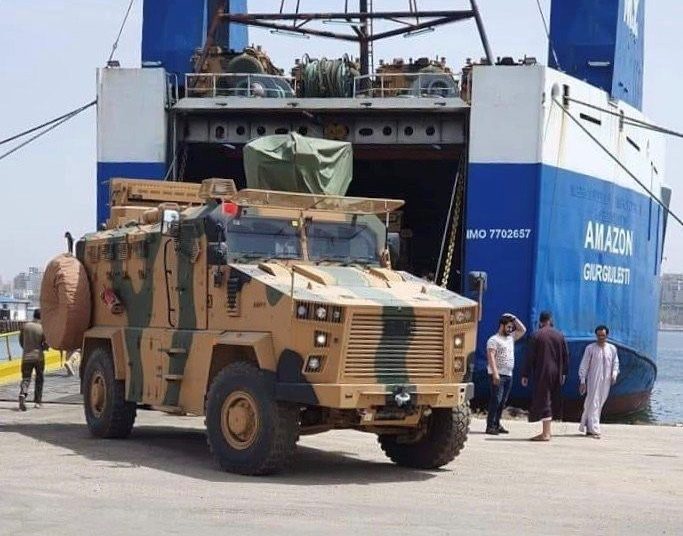
Turkey has provided military support to Libya’s Government of National Accord and allied militias fighting against General Khalifa Haftar’s Libyan National Army (LNA). The Turkish government has sent troops to Libya and transferred jihadists from Syria’s Idlib region to Libya, in line with a security agreement signed in November 2019 by President Recep Tayyip Erdogan and Fayez al-Sarraj, former head of the UN-recognized GNA. It was rumored that Sarraj’s resignation last year was due to President Erdogan’s persistent demands on a Turkish businessman close to him.
