Close Menu
Xsum NewsXsum News

    Stay Updated.

    Get the latest Africa-focused business & infrastructure news and more directly to your inbox.

    What's Hot

    Mining Review Africa launches French and Portuguese versions to bridge regional digital divide

    Building South Africa’s next chapter through sustainable infrastructure

    Southern Africa Eco-Infrastructure Summit 2026 accelerates sustainable infrastructure and green real estate investment across the southern region

    Facebook X (Twitter) Instagram
    Trending
    • Mining Review Africa launches French and Portuguese versions to bridge regional digital divide
    • Building South Africa’s next chapter through sustainable infrastructure
    • Southern Africa Eco-Infrastructure Summit 2026 accelerates sustainable infrastructure and green real estate investment across the southern region
    • Sustainable infrastructure strengthens South Africa’s future
    • Initial 11 rail operators selected for 41 routes as South Africa takes major step in opening up freight rail to private sector
    • Risk mitigation focused as SA opens rail and port networks to private participants
    • AIHS partners with Federal Department of Housing and Urban Development at 18th Housing Show
    • AIHS mourns Raila Odinga and celebrates his work in affordable housing and urban development
    X (Twitter) Instagram YouTube LinkedIn TikTok
    Xsum NewsXsum News
    • African Development Bank
    • Africa Finance Corporation
    • All Africa – Construction & Infrastructure
    • Africa Intelligence
    • Construct Africa
    • More
      • Mining Review Africa
      • Energy Capital Power
      • Sustainability & Climate-Resilient Infrastructure
      • Private-Sector Infrastructure Players
      • Urban Development & Housing
    Xsum NewsXsum News
    You are at:Home»Africa Intelligence»African business schools double their problem-solving skills amid AI integration
    Africa Intelligence

    African business schools double their problem-solving skills amid AI integration

    Xsum NewsBy Xsum NewsFebruary 18, 2026No Comments4 Mins Read1 Views
    Facebook Twitter Pinterest Telegram LinkedIn Tumblr Email Reddit
    Share
    Facebook Twitter LinkedIn Pinterest WhatsApp Email

    On a recent afternoon in Lagos, an MBA student preparing for a marketing strategy assignment entered some prompts into an artificial intelligence tool.

    The software created sophisticated campaign plans within seconds that once might have taken days to assemble. He was impressed by her speed. The instructor became uneasy at the peace.

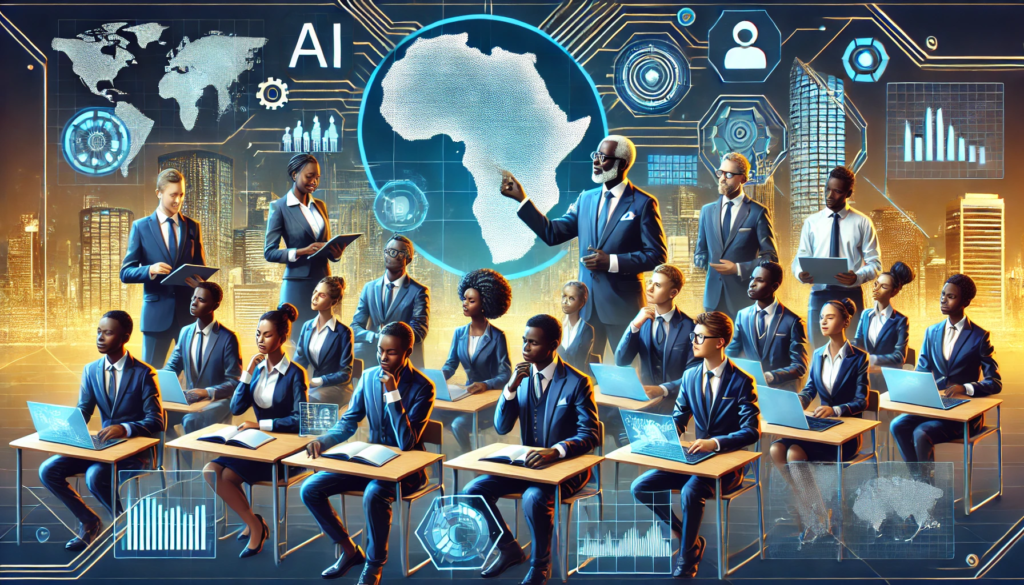
    This quiet tension captures the broader changes currently unfolding across African business schools. Artificial intelligence (AI) is changing the way people work and the way knowledge is created, shared, and applied across industries.

    In response, management schools across the continent are redesigning their curricula to focus on skills that are still difficult to replicate by machines, such as creativity, critical thinking and human judgment.

    A BusinessDay survey of 12 of Africa’s more than 100 business schools showed that institutions have developed clear ethics and usage policies, including a focus on experiential learning, oral defense, presentations, and field-based projects using local data, to instill creativity and critical thinking in students amidst AI integration.

    Africa is at a defining moment as AI reshapes industries, governance, and economies around the world. The continent has an opportunity not only to adopt emerging technologies, but also to shape them based on its realities, values ​​and development priorities.

    But education experts warn that without a carefully designed ethical and learning framework, the rapid adoption of AI could deepen inequalities or produce graduates trained in systems less suited to African markets.

    Ogechi Adeola, vice-chancellor for research, innovation and enterprise at the University of Kigali, says AI is already embedded in Africa’s education ecosystem.

    “The real question is how institutions design ethics, pedagogy, and assessment systems that ensure that AI enhances learning rather than diminishes it,” she says.

    However, she stressed that over-reliance on AI tools risks weakening students’ ability to think independently. Adeola noted that management education exists to build problem solvers who can navigate uncertainty, a skill that cannot be outsourced to algorithms.

    As a result, business schools are expanding their course offerings to explore how AI will transform marketing, finance, operations, and organizational leadership. This change will also necessitate deeper engagement with governance, ethical decision-making, and the social impact of automation.

    Henry Ogundria, director of learning innovation at Lagos Business School, believes that AI can positively transform education if implemented carefully.

    He says the technology can make learning more personalized, interactive and hands-on through advanced simulations.

    “AI is not going to replace an MBA,” he explains. “This requires business education to focus on what humans do best: critical thinking, ethical judgment, and creative decision-making.”

    Still, the transition is far from seamless. Across Africa, and particularly in Nigeria, educational institutions face structural constraints such as gaps in digital infrastructure, unequal access to technology, and limited teacher training.

    There are also concerns that AI systems trained primarily on Western datasets may incorporate foreign business assumptions that do not reflect local realities.

    “We often import models developed elsewhere,” Ogundurile says. “African markets operate differently, and education needs to reflect those differences.”

    To address these risks, educators are calling for concerted reforms. Universities are introducing stricter guidelines governing the use of AI in teaching and assessment. Traditional exams are increasingly being supplemented by oral presentations, field research, and real-world problem-solving projects using local data.

    Experts also emphasize the importance of embedding AI literacy across business sectors. Students must not only learn how to use AI tools, but also how to question, examine, and adapt their output.

    Ethical issues such as algorithmic bias, data privacy, and turnover are increasingly being treated as core management subjects rather than something that experts add on.

    Regulators are expected to play a central role. National education authorities and professional bodies are under pressure to establish minimum AI competency standards and encourage the development of African datasets and case studies.

    Such a move could reduce reliance on general global models and enhance locally relevant research.

    Despite the challenges, AI is enabling data-driven decision-making, advanced simulations, and around-the-clock personalized learning, accelerating the evolution of business education.

    Some educational institutions have begun implementing AI-assisted education tools that allow instructors to create interactive learning experiences.

    However, many schools still lack the infrastructure, funding, and research capacity to fully integrate technology. Analysts warn that without investment, Africa risks widening the gap in global competitiveness in management education.

    For now, business schools across the continent are taking cautious but decisive moves. Their challenge is not just to teach students how to use artificial intelligence.

    This is to ensure that graduates maintain their ability to think independently in an increasingly automated world.

    Charles Ogwo

    Charles Ogwo is an active journalist who has been promoting innovation in education and business for over a decade. He leads efforts to leverage technology to enhance storytelling and build top-performing teams. Charles is passionate about leveraging technology to inform, engage, and empower communities.

    African business double Integration problemsolving schools skills
    Share. Facebook Twitter Pinterest LinkedIn Reddit WhatsApp Telegram Email
    Previous ArticleHow South Africa will tackle the water crisis: Insights from President Ramaphosa’s speech
    Next Article Ghanaian economist goes to Africa: Turning great power despair into infrastructure
    Xsum News
    • Website

    Related Posts

    TV show with Thinus: Angry MultiChoice executives sit out Canal+ after decision-making moves to Paris, frustrated and worried about future

    March 26, 2026

    BusinessDay launches Africa’s first “She Means Business”

    March 26, 2026

    BusinessDay launches Africa’s first business intelligence ecosystem for women, “She Means Business” |

    March 25, 2026
    Leave A Reply Cancel Reply

    Top Posts

    African Development Bank Group and Nedbank Group sign multi-billion rand funding partnership to transform housing access and boost African trade

    December 19, 202529 Views

    A United Continent on the Move: Ambassador Kouyateh’s Call for an African Logistics Renaissance

    November 20, 202529 Views

    Eni secures multi-million dollar loan for African FLNG project

    January 26, 202622 Views

    African Development Fund and WHO collaborate to save Sudan’s health system

    November 17, 202522 Views
    Don't Miss
    Mining Review Africa April 17, 2026

    Mining Review Africa launches French and Portuguese versions to bridge regional digital divide

    670 VUKA Group’s flagship publication, Mining Review Africa, this week launched a French and Portuguese…

    Building South Africa’s next chapter through sustainable infrastructure

    Southern Africa Eco-Infrastructure Summit 2026 accelerates sustainable infrastructure and green real estate investment across the southern region

    Sustainable infrastructure strengthens South Africa’s future

    Stay In Touch
    • Twitter
    • Instagram
    • YouTube
    • LinkedIn
    • TikTok

    Stay Updated.

    Get the latest Africa-focused business & infrastructure news and more directly to your inbox.

    About Us
    About Us

    Xsum News is Africa’s digital window into the future of business. We tell stories of innovation, enterprise, and investment that are shaping the continent’s economic rise. African Business, Added Up.

    X (Twitter) Instagram YouTube LinkedIn TikTok
    Our Picks

    Mining Review Africa launches French and Portuguese versions to bridge regional digital divide

    Building South Africa’s next chapter through sustainable infrastructure

    Southern Africa Eco-Infrastructure Summit 2026 accelerates sustainable infrastructure and green real estate investment across the southern region

    Most Popular

    African Development Bank praises Algeria’s development model, aims to replicate its success across the continent

    Considering the redefinition of African capital by UBA and Arauba

    G20 Energy Investment Forum brings together Africa’s top finance, insurance and technology leaders

    © 2026 Xsum News. All Rights Reserved.
    • 🌍 About Xsum News
    • 📬 Contact us
    • Privacy Policy
    • Terms & Conditions
    • Disclaimer

    Type above and press Enter to search. Press Esc to cancel.