


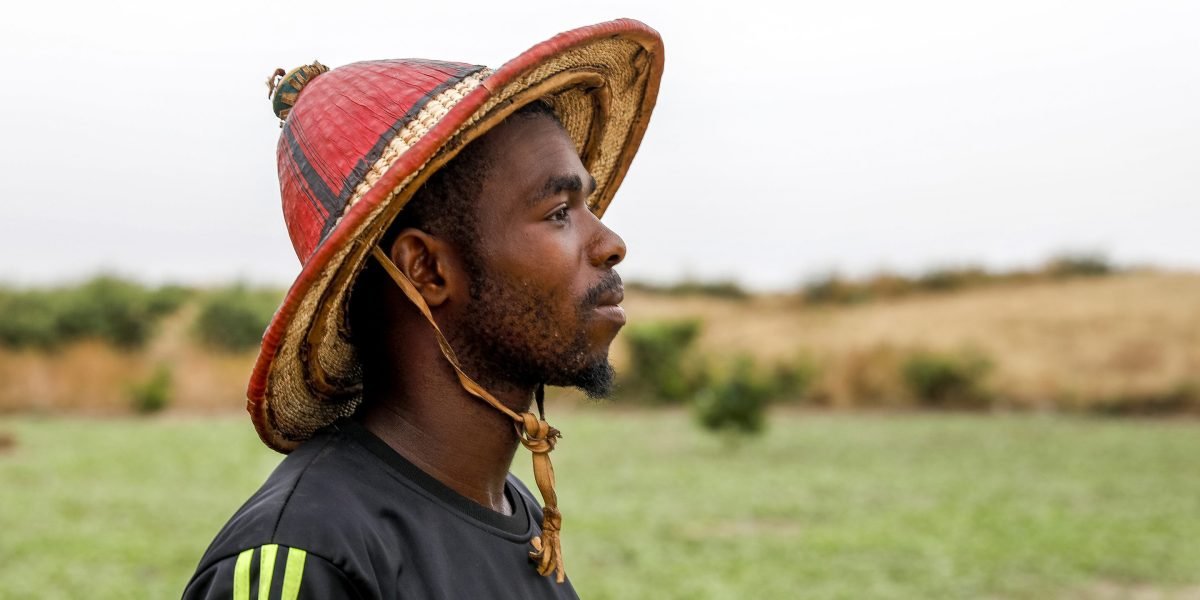
On a blistering afternoon in Senegal, 33-year-old farmer Filly Mangassa was stacking peanuts on his horse-drawn cart, kicking up dust.
Ten years ago, he left his village and headed to the capital, Dakar, with dreams of becoming a professor. But the high cost of living and lack of jobs put that dream out of reach.
“Especially since COVID-19, companies haven’t been hiring and prices have gone up,” said Mangasa, who has a master’s degree in criminology. “My father and grandfather were both farmers, so I thought why not use that experience to return to my hometown and make a living from farming.”
In many parts of Africa, farming has long been considered a low-status job, pushing young people to cities in search of clerical jobs.
“For my father and some members of my family, I think it was seen as a step backwards for me to go back to the countryside,” Mangasa said.
However, that perception is changing. Rising food prices, investment in irrigation, and access to new technologies are making agriculture more profitable. Governments and nonprofit organizations are now funding programs that teach advanced agricultural skills and provide farmers with equipment, fertilizers, pesticides, and seeds.
“When my father saw that I had a clear and thorough business plan, he encouraged me and helped me with the administrative procedures to acquire the land,” Mangasa said.
He points to the trend of young Africans leaving cities to try their hand at farming. Mangasa says he earns about 2 million CFA ($3,500 a year), far more than the average Senegalese salary of about $2,500 a year.
Africa is the world’s most rapidly urbanizing region, with cities growing at an average rate of 3.5% per year. As the urban population increases, so does the cost of living.
According to the World Bank, places like Dakar and Kenya’s capital, Nairobi, have median rents and food prices approaching those of major European cities, even though median salaries are significantly lower.
Meanwhile, according to the African Development Bank, between 10 and 12 million young Africans enter the job market every year, but only about 3 million formal jobs are created.
“Many of my friends who graduated at the same time as me are now working as motorbike taxi drivers and barely making ends meet,” Mangasa said.
Supporting young farmers in acquiring land
Mangasa currently owns a 32-acre farm where he grows peanuts, corn, vegetables and fruit. He received funding to purchase the land from a World Food Program initiative that helps young Africans start careers in agriculture.
It was launched in 2023 and is scheduled to run until early 2027, and has supported approximately 380,000 people in setting up agricultural businesses.
The organization works with local governments to help young farmers acquire land, but they often face challenges due to complex ownership systems and difficulties in accessing loans as young people are considered high-risk.
According to WFP, the program has supported more than 61,000 people in Senegal, and more than 80% have set up farms. We also have operations in Ghana, Nigeria, Mozambique, Uganda, Rwanda, Kenya and Tanzania.
“Our research shows three main barriers for young people to enter agriculture: limited access to land, finance and inputs, lack of practical skills and difficult market conditions – knowing when to sell, how to add value and how to sell products,” said Pierre Lucas, WFP’s Country Director for Senegal.
Senegal, like many African countries, suffers from food insecurity, exacerbated by donor funding cuts and worsening climate conditions.
Ibrahima Hattie, an agricultural economist at the Senegal-based think tank Prospective Agricultural and Ral Initiative, said the region is also recovering from colonial times.
“In Senegal, for example, farmers were pressured to grow peanuts to sell in France instead of food crops,” Hattie says.
Scarce arable land and soil degradation further constrain food production.
But now, with many young farmers moving to higher-value crops and having better technology, production is increasing, Hussey said, predicting that staple food prices could fall as more locally produced food enters the market.
Agriculture becomes an alternative to migration
Senegal is the main starting point for migrants seeking to reach Europe via the dangerous Atlantic route. Authorities see agriculture as a job creation tool to keep young people at home and are launching campaigns in rural areas most affected by migration.
“We are convinced that agriculture and livestock are the only sectors that can create the hundreds of thousands of jobs that Africa’s young people need,” Senegal’s Agriculture Minister Mahbouba Diagne told reporters in October.
Adama Sein, 24, once dreamed of going to Europe, but didn’t have the money to pay smugglers. He moved to Dakar in 2020 but struggled to make a living as a construction worker. There he learned about WFP’s efforts.
“In a way, the discovery of agriculture saved my life,” Sanneh said. “If I had continued working in construction, sooner or later I would have tried to cross the ocean.”
He currently keeps poultry and grows peppers on a five-acre farm in the village.
“I’m still far from where I want to be with my business, but at least I’m saving a lot of money and my life is less stressful than in the city,” Sane said. “Many young people think of farming as a ‘small job,’ but there is growing public awareness that agriculture can be the key to Senegal’s development.”
Three other immigrant candidates are currently working in Mangasa.
Mamadou Camara, 22, Issa Traore, 22, and Madassa Kebbe, 23, were living in Mali’s capital, Bamako, struggling to find work. Their family was helping raise money for an Atlantic journey to Europe via Guinea-Bissau, but they said the smugglers who were there disappeared along with it.
They decided to return home through Senegal, where they met Mangasa.
“I empathized with them because I know what it’s like to work hard and still live while your family depends on you,” Mangasa said. “We wanted to show that there are opportunities here for young people.”
___
The Associated Press receives funding from the Gates Foundation for global health and development coverage in Africa. AP is solely responsible for all content. Learn about AP’s standards for working with philanthropy, a list of supporters, and funded areas at AP.org.
