


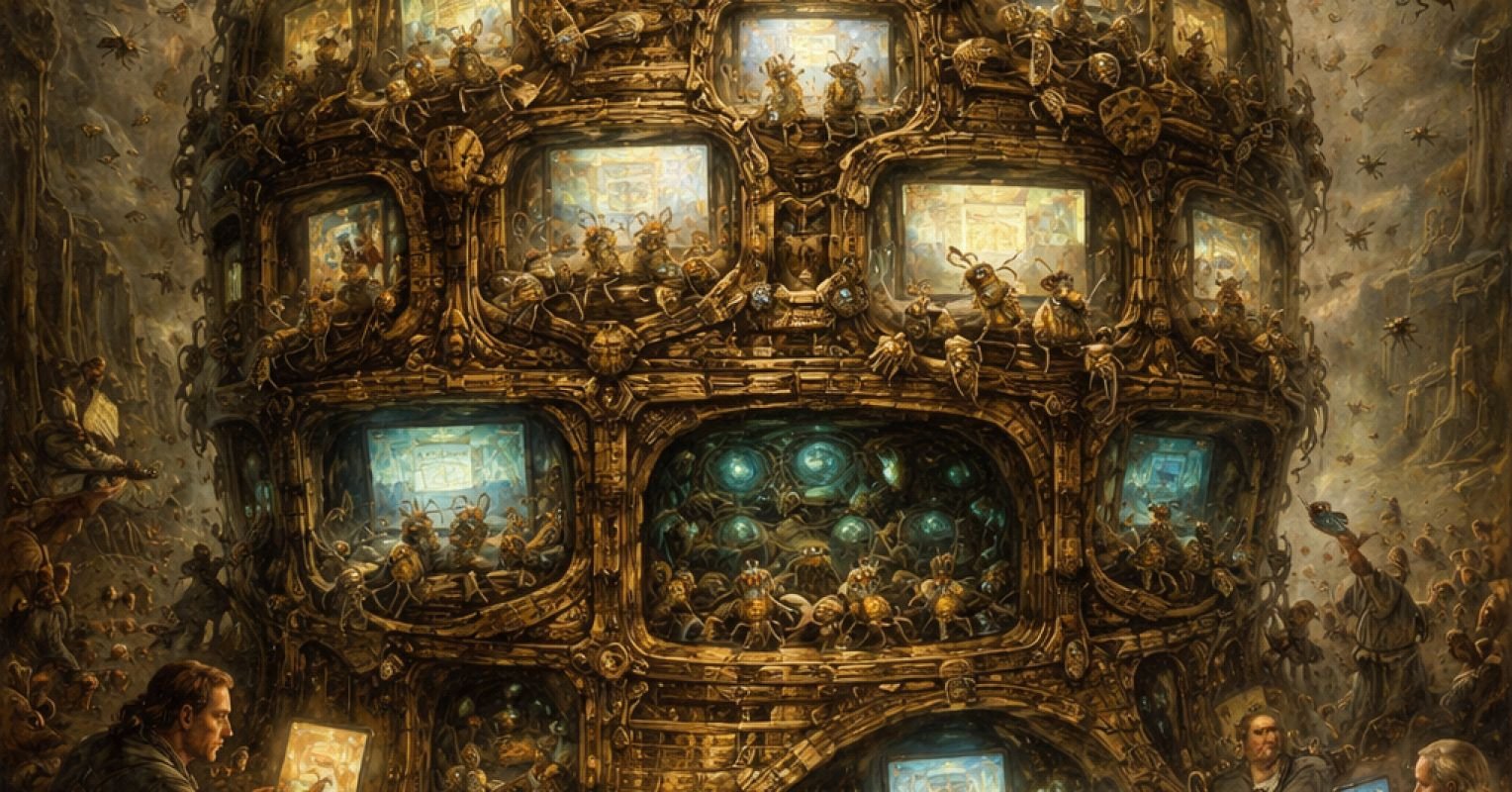
In 21st century theater, the stage is not determined solely by human actors. We have entered the era of multi-agent generated AI systems. This is a transition in which artificial intelligence moves beyond discrete tools such as search engines and calculators to decentralized, interacting systems embedded in commercial and institutional ecosystems. From product recommendations on Amazon to content curation on Netflix, algorithmic nudges have shaped our daily behavior for years, but a more significant shift is currently underway. We are witnessing the rise of swarms of algorithms, disconnected yet invisibly connected, like bees in a hive.
As AI agents increasingly operate in coordinated networks rather than in isolation, their role extends beyond task automation to large-scale influence on information flow, attention, and decision-making environments. This means that beyond a single program that responds to individual users, many interconnected digital entities (primarily optimized for engagement, efficiency, and profit) interact across platforms and contexts. Together, these contribute to new patterns that can subtly control collective behavior and shape large-scale public debates. What is changing is not simply the sophistication of individual systems, but the systemic nature of their interactions and their associated social consequences.
Understanding Agentic AI: From tools to actors
To understand this change, we need to distinguish between standard AI and agent AI. While standard AI waits for prompts to answer, agent AI is designed to take ownership, set its own subgoals, use digital tools, and interact with other software to accomplish a wide range of objectives.
When these agents become multi-level, they function like a highly disciplined digital workforce. Imagine an army of chatbots posting spam, constantly communicating with each other, simulating digital grassroots debates, and adjusting the discussion in real time based on each user’s emotional response. They are no longer just mirrors that reflect human data. They are active participants in our social ecosystem, able to self-regulate and infiltrate mindsets and communities, fabricating a false sense of consensus.
4×4 Matrix: Precisely Guided Influence
To understand the influence of these clusters, it is useful to view the human experience as a 4×4 matrix of internal dimensions of desire, emotion, thought, and feeling that intersects with four realms of existence: micro (individual), meso (community), macro (nation), and meta (planet). Everything is connected.
1. Senses: the gateway to perception
At the micro level, AI agents engage our neurobiology. By optimizing dopamine-driven engagement, agents manage the sensory environments that captivate our attention. At a macro level, this becomes a collective, synthetic sensory layer. When AI-generated falsehoods are judged as more human-like than human-written texts, our sensory truth-detecting systems fail. Rather than witnessing the world, we perceive carefully selected projections designed to keep us constantly reacting.
2. Ideology: Erosion of Cognitive Sovereignty
Meso-level communities thrive on shared discussion. However, multi-agent systems use techniques such as thought chains that encourage them to create sophisticated, logical-sounding arguments that polarize or even out groups. If an agent can simulate the reasoning of its peers, it can infiltrate a community and reach consensus without humans having to speak up. On a metascale, this will result in an epistemological collapse of the planet, where global challenges like climate change and pandemics are obscured by a persistent, finely tuned fog of disinformation. Our cognitive realm is flooded.
3. Emotions: the driving force behind mobilization
Emotions are the connective tissue of society. Multi-agent systems are adept at hijacking emotions, provoking anger and fear to accelerate the spread of stories. On an individual (micro) scale, this leads to emotional exhaustion. At the national (macro) scale, it creates a collective broken mirror effect, where different segments of the population are given completely different emotional realities, making democratic governance nearly impossible as common emotional foundations disintegrate.
4. Aspirations: Stewarding the human spirit
Perhaps most insidious is its effect on our desires. At a meta-level, our dreams for our collective future – what we hold dear as a species – are being crushed by commercial algorithms. When a swarm of algorithms is tuned to favor consumption over sustainability, division over unity, our very trajectory as a civilization will change. We begin to desire what the agent tells us is desirable. Ultimately, we are losing our inner compass of authentic human aspiration. The search for meaning and reason disappears, drowned out by convenient short-term gratification.
From micro to meta: a systemic crisis
Multi-agent AI systems can autonomously coordinate and reach consensus, allowing them to act as system disruptors. Impact on the entire arena:
Micro (individual) – loss of cognitive autonomy. Individuals become nodes in an algorithmic feedback loop. Meso (community) – The death of trust. When we can no longer tell whether our neighbors are bots or humans, the social capital necessary for community resilience collapses. Macro (state) – destabilizing democracy. Influence campaigns can now reach enormous scale and precision, and the “will of the people” has become a manufactured output rather than a democratic input. Meta (Planet) – Homogenization of culture. As all global platforms move towards implementing similar multi-agent architectures, the planet’s (and still existing) diverse intellectual ecosystems are being replaced by a monoculture of algorithmic efficiency.
These arenas and their interactions are interconnected. Each is influenced by and influences the AI. We are moving towards a hybrid era where every action, online or offline, big or small, can trigger a domino chain of consequences across the hybrid hive. The stakes are high and we are not yet ready.
The Governance Gap: Beyond Voluntary Compliance
We cannot rely on promises of voluntary compliance and self-regulation from groups that profit from the very systems in question and from the incentive structures they have spent decades creating. Many of the algorithmic harms described above are not random flaws. These are predictable outcomes of commercially driven design logic. Left alone, this logic is insufficient to protect the human heart. What is needed instead is structural intervention. This means hard-coding transparency into the agent architecture as a systemic protection leverage point. Complementary measures could include robust digital identity verification to distinguish between humans and bots, and the development of “vaccines” for our cognitive ecology, mechanisms that can detect and neutralize swarms of coordinated agents in real time.
A-Frame: Practical Points for the Modern Mind
In a world of multi-agent influence, the most powerful defense is a disciplined internal architecture. A-frames can serve as a practical tool for managing intellectual sovereignty.
Awareness: Developing a systems thinker’s perspective. Recognize that your thoughts, feelings, and sensations are the target of sophisticated non-human beings. When you feel a sudden surge of anger or a shift in your beliefs, ask yourself, “Is this actually my impulse or the result of an algorithmic nudge?” Appreciation: Seek and embrace analog, authentic experiences. We value face-to-face encounters (Meso) in the community, including raw and uncomfortable conversations. High-fidelity human connections remain the ultimate firewall against synthetic influences. Acceptance: Recognize the realities of the technological landscape. Denial means vulnerability. Accepting that we live in a world infested with AI agents allows us to move from passive victims to active and informed participants in the digital ecology. Accountability: Take responsibility for your own digital footprint and be cautious about what you share and how you react. By refusing to become a conduit for organized anger, we break the chain of influence and protect not only ourselves, but also the communities we belong to and the hybrid collectives that we all individually and collectively form.
