


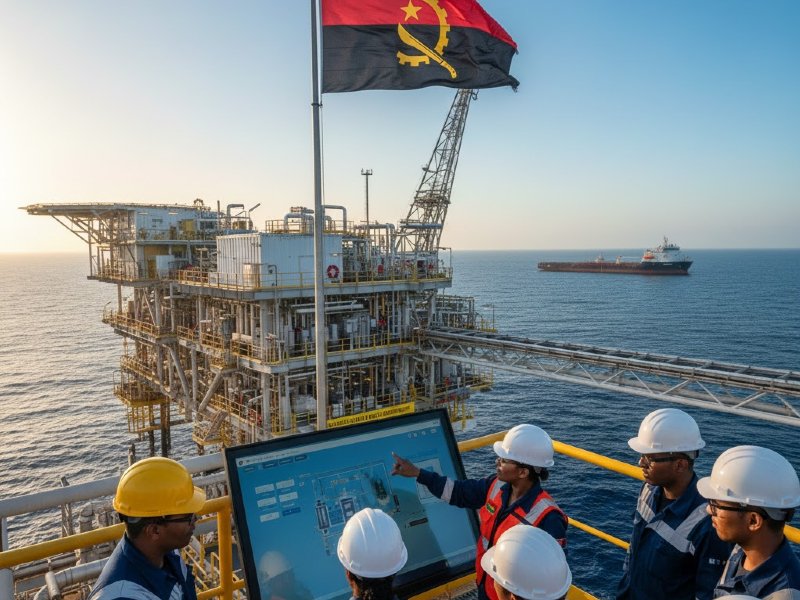
Angola is looking to convert upstream momentum into long-term capabilities through a 2025 industry-academia collaboration with the Massachusetts Institute of Technology (MIT), centered on the Institute of Technical Sciences of the Superintendent of Polytechnics (ISPTEC) and state-owned oil company Sonangol. Launched with the support and vision of the Ministry of Mineral Resources, Oil and Gas, this cooperation marks the beginning of a lasting and evolving relationship aimed at strengthening Angola’s technical workforce and academic institutions, rather than a limited-time training program.
Rather than a one-off exchange, this partnership aims to establish a framework for ongoing research, academic collaboration and skills transfer, increasing ISPTEC’s reputation and technological depth over the long term. This initiative reflects a broader shift in Angola’s development strategy, which treats skills, research and institutional capacity as critical infrastructure for the oil and gas sector.
Enabling global STEM collaboration
At the academic level, this partnership is underpinned by MIT Africa, which has a clear strategic vision to position ISPTEC as one of Africa’s leading technical universities. This goal is pursued through close collaboration between MIT, ISPTEC, Sonangol, and the Angolan government, aligning academic excellence with national industrial priorities. Two initial programs at MIT Africa form the foundation of this effort: Global Teaching Labs and Global Classroom. These initiatives aim to foster structured knowledge exchange, curriculum development, collaborative research, and academic teaching, embedding global standards into Angola’s national education system and strengthening ISPTEC’s institutional capacity.
Complementing the academic pillar is MIT’s Industry Collaboration Program, with Sonangol serving as an anchor partner and directly linking industry to collaborations. A Sonangol spokesperson told Energy Capital & Power that the company is the second company to undertake this kind of initiative in Africa, strengthening its role as a conduit between global research, applied innovation and Angola’s energy sector.
Importantly, this model reverses the traditional flow of academic exchange. Rather than sending Angolan students abroad, this partnership brings international expertise to Angola while positioning local educational institutions as equal contributors. Angola’s oil and gas sector offers a uniquely rich learning environment, from mature deepwater production to frontier exploration and integrated gas development. This breadth enables collaboration across the value chain, from reservoir management and drilling optimization to gas monetization, infrastructure planning and emissions reduction.
The next generation will lead Angola’s oil and gas production
The timing of the MIT, ISPTEC, and Sonangol partnership is strategic. With a $70 billion upstream investment pipeline underway and efforts to maintain production above 1 million barrels per day (bpd), Angola is introducing innovative mechanisms to increase operational efficiency while reducing emissions. This has become increasingly evident through recent projects.
Oil exploration has low carbon solutions built into its design. Azule Energy’s Agogo FPSO, which began production in 2025, incorporates an all-electric topside and marine system, as well as a marine combined cycle power generation system. TotalEnergies’ Kaminho project is the first large-scale deepwater development in the Kwanza Basin, converting a very large crude oil carrier into an FPSO, designed to minimize emissions by reinjecting gas into the reservoir. The transition to non-associated gas development is also progressing. In late 2025, Angola’s new gas consortium began operations at the Soyo gas processing plant, marking the beginning of the country’s first non-associated gas project.
These trends highlight why Angola is emerging as an attractive destination for applied research, training and academic cooperation with industry. Within this context, the MIT Africa partnership is expected to expand beyond classroom-based programs. In the short term, this cooperation is expected to support the development of Sonangol’s new research and development center in Sumbe, which is envisioned as a hub to serve Angola’s oil and gas industry through applied research, innovation and technical problem solving.
Human capital as critical infrastructure
At its core is the collaboration between MIT, ISPTEC, and Sonangol, which bridges academia, industry, and nations. This is reinforced by Angola Oil & Gas (AOG), the country’s main industrial platform linking government, industry and academia. Held from 8-10 September 2026, AOG will foster engagement between academic institutions, administrators, technology providers, and policy makers to ensure that talent development is aligned with project execution and investment priorities. This commitment was evident at AOG 2025, where the Ministry of Mineral Resources, Oil and Gas awarded scholarships to four female petroleum engineering students, highlighting its focus on inclusion and long-term skills development. Taken together, these efforts position human capital as the enabling infrastructure for Angola’s energy future.
