


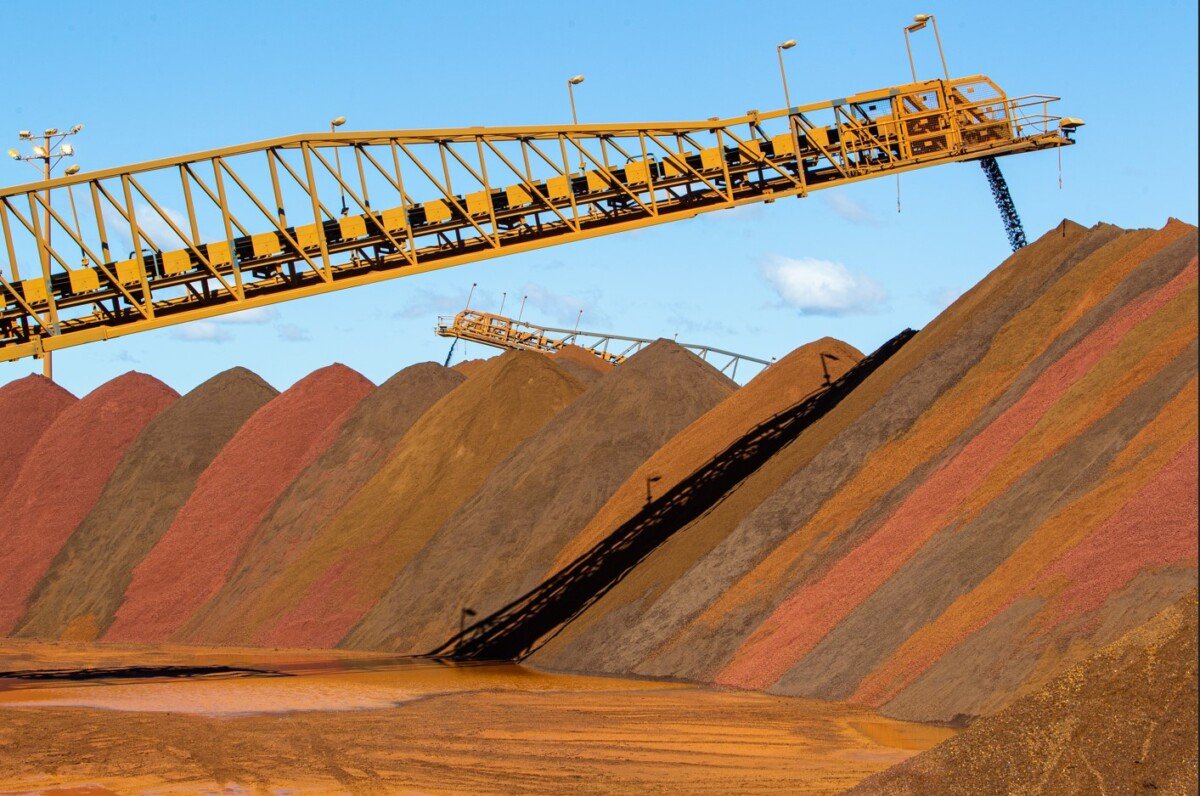
Australian iron ore is almost essential to the global steel industry.
Australia has dominated global markets since China’s rapid industrialization in the early 2000s, due to the Pilbara’s unrivaled high-quality, low-cost resources.
WA is the world’s largest supplier of iron ore, producing around 99% of Australia’s total production, according to Geoscience Australia.
In FY25, exports from the region totaled 775.7 million tonnes, accounting for $153 billion in revenue, with Pilbara ports handling 81% of Australia’s iron ore trade and 43% of global iron ore trade.
This large-scale industry has developed over more than 60 years on the back of painstaking exploration, large-scale investments, and development resources that were previously considered unsaleable.
As a result, Pilbara has become one of the most recognizable names in the iron ore industry.
Pilbara: the treasure of iron ore
On 24 November 1960, the Federal Government agreed to a partial lifting of the iron ore export ban that had been in place in Australia since 1938, ushering in a new era for Australia’s iron ore industry.
Coupled with Japan’s industrialization in the 1960s, iron ore developers and geologists were motivated to explore WA’s remote Pilbara region, which was strategically located close to major Asian markets.
Iron ore production in the Pilbara increased rapidly, exceeding 100 tonnes per year by the 1980s. With the development of Taiwan and South Korea in the 1970s and 1980s, exports increased further by the early 2000s to over 200 tons per year.
China’s industrialization ushered in a massive 21st century mining boom in the Pilbara, with Australian exports increasing to more than 800 tonnes a year by 2016.
Australian producers were quick to capitalize on China’s surge in demand, overtaking Brazil in 2007 to become the country’s largest exporter of iron ore, a title previously unrivaled.
Australia’s industry has developed at an unprecedented rate, nearly quadrupling between 2002 and 2018, and Brazil’s exports increased by around 160%.
During this period, more than $140 billion (US$93 billion) was invested in the Pilbara iron ore project, and two major new producers, Fortescue Metals Group (ASX: FMG) and Hancock Prospeting’s Roy Hill, emerged, complete with their own mine, rail and port infrastructure.
Today’s Pilbara is home to a vast network of mines, heavy rail and port infrastructure.
Global market trends
China remains the world’s largest steel producer and consumer, with strong domestic steel demand supported by rapid industrialization and infrastructure growth. According to the Reserve Bank of Australia, favorable government policies, significant government investment and the shift of global steel production to developing countries such as China have contributed to the country’s market dominance.
According to the Minerals Council of Australia (MCA), Japan remains the world’s second largest market, with Asia as a whole accounting for around 82% of total global seaborne imports, and market proximity is a major advantage for Australian producers.
For the past 40 years, iron ore prices have been determined by private negotiations between a small number of miners and steel manufacturers who control both the spot and contract markets. Prices were determined in annual benchmark negotiations between major iron ore producers and importers until 2006, when Chinese company Baosteel began negotiations.
China has long sought to control market fluctuations. In 2009, in consultation with the Chinese government, then BHP chief executive Marius Kloppers abandoned the fixed price system in favor of floating market prices proposed by China, which at the time dropped to $118 (US$78) per tonne.
Vale and Rio Tinto (ASX: RIO) followed shortly after BHP, breaking with the tradition of annual benchmark prices in favor of index-based quarterly prices in 2010.
But less than two years later, Chinese pressure backfired and prices rebounded to $245 per tonne (US$170 per tonne), a major victory for Australian producers. BHP completely shifted the dynamics of the market, leaving China to the whims of volatile pricing.
In response to soaring iron ore prices, the Chinese government established the CMRG in 2022 to return to private contract negotiations with the aim of mediating and centralizing iron ore purchases to improve China’s pricing power in the global market.
China’s demand is expected to fall in the coming years, and ore prices are expected to take a hit, creating a new hurdle for Australia’s most profitable export industry.
South Flank: The future of Australian iron ore
Australia’s Pilbara miners have played a pivotal role in China’s rise to economic dominance, but tensions between stakeholders are tumultuous.
Despite this, Australia remains the undisputed global iron ore heavyweight. According to the MCA, an estimated 70 tonnes of JORC-compliant resources on a steel basis remain, and Australia is expected to be able to sustain production for decades to come.
Pilbara producers account for the largest proportion of high-grade iron, low-cost DSO hematite, one of the main reasons Australia has become the world’s largest iron ore producer. While some major producers, such as BHP’s Yandy iron ore mine in Western Australia, are nearing the end of their lives, there are still significant untapped resources.
BHP’s South Flank is the largest new iron ore mine in Australia in more than 50 years and one of the largest in the world. The South Flank iron ore mine, located in Mine Area C 156 km northwest of Newman, is a $4.5 billion development.
With a production capacity of 80 tonnes per year, South Flank fills the gap left by traditional mines left by closures or decommissioning due to ore depletion, including the aging Yandy mine. Together with Mining Area C, it will form the world’s largest operating iron ore hub, producing 145 million tonnes of iron ore annually.
South Frank integrates the latest advances in autonomous fleets, digital connectivity and modular design to set new standards for the future of the resource industry.
The project started in July 2018 and reached first ore in May 2021. South Flank is expected to exceed its 80 million tonne nameplate capacity in its first full year of operation and supply the global steel market for 25 years.
South Flank is changing the Pilbara iron ore landscape. This quickly became a cash cow asset for BHP, supporting an unprecedented third consecutive year of record production in FY25 at the company’s WA Iron Ore (WAIO) business.
State-of-the-art infrastructure and innovative technology have enabled South Flank to overcome commissioning challenges and quickly ramp up to full production capacity.
In October, BHP confirmed a shift to focus on operational efficiency and cost control for its iron ore business in the face of market volatility. The pinnacle of this is the South Flank.
Despite the Pilbara’s vast resource base and established infrastructure, there are several challenges shaping the future of Australian iron ore production. The emergence of new suppliers has made the global market environment more competitive, but Australian producers are well placed to continue to thrive in this environment.
Concerns about the Pilbara’s dominance have been raised as a wave of new iron ore mines outside Australia brings new competition, including the Simandou project in Guinea, Africa.
Despite being dubbed the ‘Pilbara killer’, Simandou’s maximum production capacity is 120 million tonnes a year, 25 million tonnes less than BHP’s South Flank and Mine Area C operations alone. Australia is expected to export around 905 million tonnes of iron ore this year, with Africa expected to export significantly less at 93 million tonnes, according to the Commonwealth Department of Industry, Science and Resources (DFISR).
Even with Simandou’s full production capacity, Africa is expected to export less than 250 million tonnes of iron ore annually. Despite its significant resources, it is unlikely that Simandu will displace the Pilbara as one of the world’s leading producers. However, how the iron ore market will take shape remains to be determined.
DFISR expects production at Simandou to support a 60% increase in iron ore exports from Africa between 2024 and 2027. However, geopolitical instability and environmental, social and governance (ESG) challenges could prevent Simandou from reaching its full potential.
In the global race towards net zero, greenhouse gas emissions are receiving increased attention and steel mills are changing the way they approach production. Steel mills are increasingly demanding higher grades, which is reflected in relative product prices across ore quality categories, which is influencing market trends.
South Flank and other Pilbara-based operations have clear advantages, including geographic proximity to consumers, established export infrastructure, high quality ore and stringent ESG compliance.
There are also opportunities to further increase production and reduce costs by increasing process and supply chain optimization and automation. In this area, the Pilbara is already considered an industry benchmark.
Combining our extensive network of resources and infrastructure with world-class mining technology and workforce, we operate in the Pilbara as well as the South Flank and are positioned to continue to dominate the global iron ore market.
