


Cape Town Mayor Jordyn Hill-Lewis said the city was on track to achieve greater infrastructure investment than Gauteng’s three metros combined, according to the city’s latest infrastructure report.
City touts R120 billion infrastructure pipeline
The city claimed to have an infrastructure pipeline worth R120 billion over 10 years, which he said was a record for South Africa. Cape Town officials say around 130,000 construction jobs will come from capital investment during the current term alone, with an economic impact of R17 billion.
Cape Town has significantly increased investment levels, with the proposed capital budget for 2027-28 at R14.7 billion, more than double this period’s original budget, compared to R6.9 billion in 2022-23, the city said. The city projects its capital budget will reach R14.4 billion by 2027/28, more than the budget of all three Gauteng metros combined.
Investment breakdown by sector
According to the city, 45% of the investment will go to basic services such as water, sanitation and energy, with 18% going to transportation, 11% to housing and 8% to public spaces and amenities. “We are building South Africa’s cities of hope by investing in the basic infrastructure needed to support functioning cities,” Hill-Lewis said at the report’s launch.
Comparison with Gauteng Metro
Officials in Cape Town offered some comparisons with cities in Gauteng province. The City claimed that only 75% of Cape Town’s pro-poor capital budget exceeded Johannesburg’s entire capital budget (R10 billion compared to Johannesburg’s total of R8.7 billion in 2025-2026).
Cape Town announced it invested more in infrastructure this period than Johannesburg and Tshwane combined, at R25.7 billion from 2022-23 to 2024-25 compared to R22.8 billion for the two Gauteng cities.
Claims related to water and wastewater infrastructure
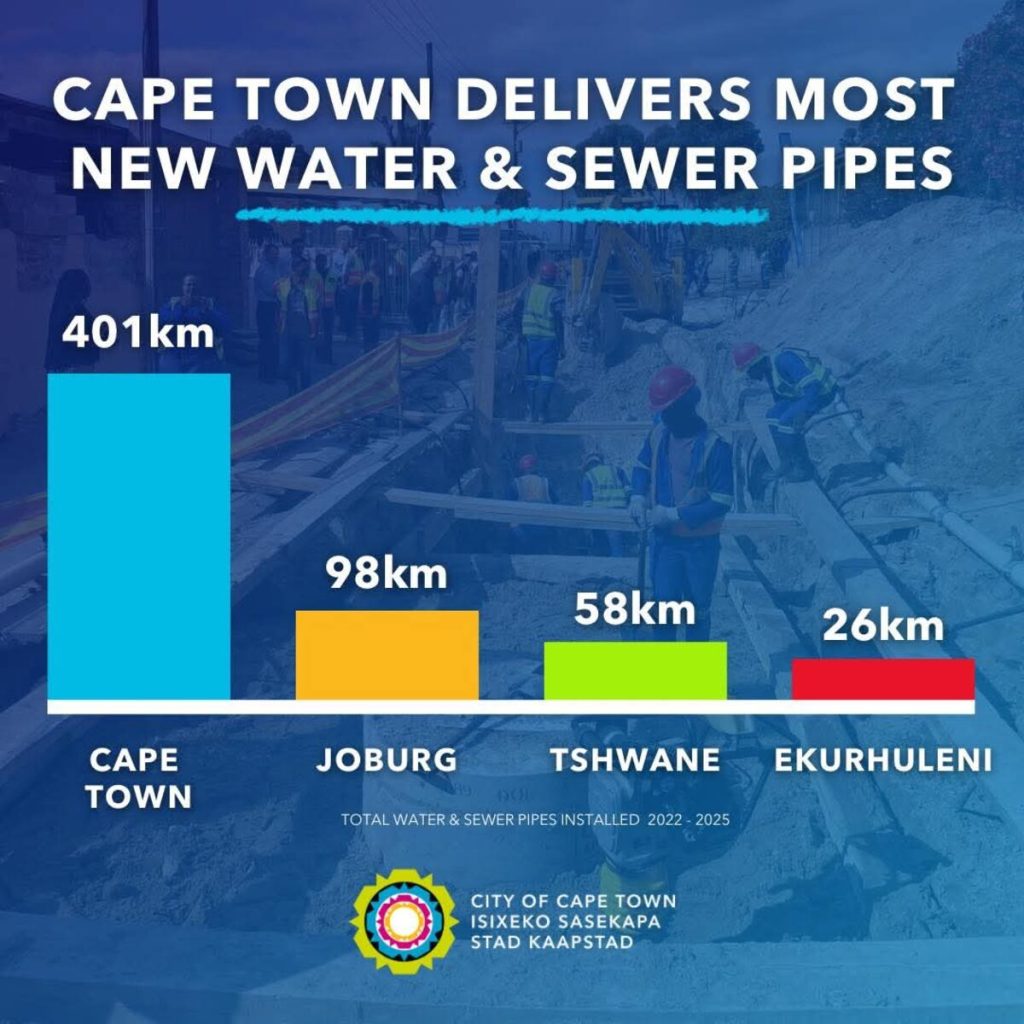
The city highlighted pipe replacement as a key difference, saying Cape Town had replaced three times as many water and wastewater pipes between 2024 and 2025 as Johannesburg, Tshwane and Ekurhuleni combined.
According to the city, total kilometers of sewer and water pipes replaced:
Cape Town: 401 km Johannesburg: 98 km Tshwane: 58 km Ekurhuleni: 26 km
Key investment areas
transportation
A major transport focus for the city is the multi-billion rand MyCiti expansion from Mitchells Plain and Khayelitsha to areas of the metro south-east, which authorities are calling the largest project of its kind in South Africa. The medium-term portfolio has been expanded to include additional road reconstruction, rehabilitation, and stormwater projects. Investments in other years are related to transportation corridor development and congestion mitigation efforts.
water and sanitation
Cape Town’s new water program strategy aims to increase and diversify the city’s drinking water supply by between 70 million and 100 million liters per day over the long term. Sewage expansion and sludge reuse projects through 2039 will support population growth and urban development. The city said resilience and service reliability are being strengthened through investments in the electricity grid, upgrades to pumping stations and public-private partnership mechanisms.
waste management
The city is expanding its current landfill capacity, with a height expansion at Coastal Park pending approval in 2026, and an expansion of the Vissershok South Landfill Cell. The new landfill is expected to be completed by 2036.
energy transition
Cape Town claims to be emerging as a national leader in municipal energy transition, building what it calls a resilient, affordable and low-carbon energy system. The city is investing in power generation projects, energy efficiency and grid upgrades to achieve what it describes as a dynamic, distributed energy future.
Highlights of pro-poor spending
For 2025-2026, the city has listed major pro-poor investments, including:
R4.5 billion for a new MyCiti bus route from Khayelitsha and Mitchells Plain to Wynberg/Claremont R2 billion to replace 100 kilometers of sewerage and 50 kilometers of water pipes per year (mainly in low-income areas) Cape Flats sewer upgrades will benefit over 300,000 households R4 billion Refurbishment upgrades and repairs at Zandvliet factory providing over R3.5 billion of services to Khayelitsha and roads R34 billion to upgrade informal settlements R1 billion to upgrade and repair street lighting R39.7 million to upgrade public transport stations R272 billion to upgrade informal trade infrastructure
A complete infrastructure report is available on the city’s website.
