


Despite the high performance of large-scale onshore wind projects, the ability of African countries to secure investment in new generation assets continues to be hampered by high financing costs, limited grid capacity, and contracting and permitting delays.
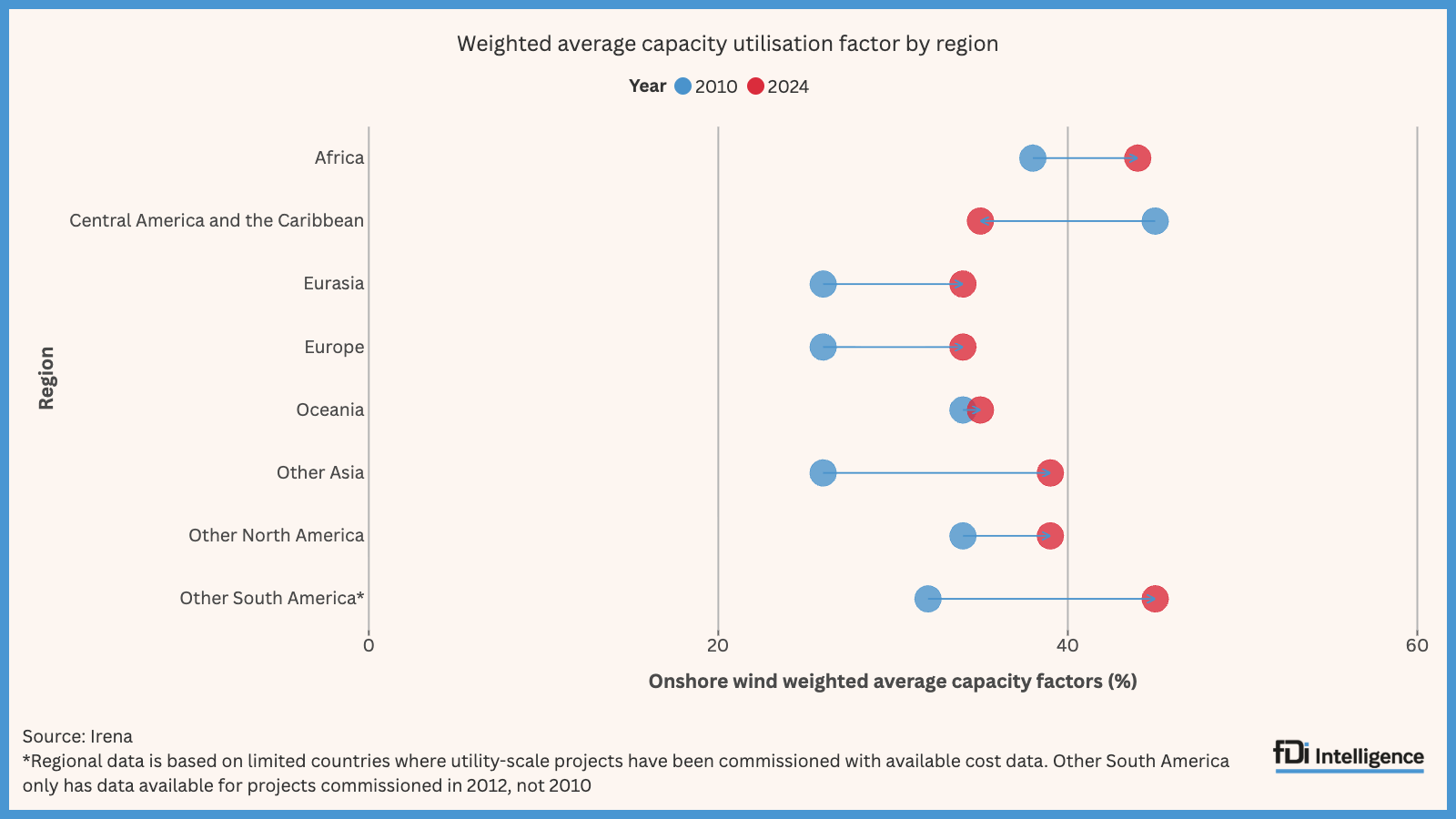
According to data from the International Renewable Energy Agency, the weighted average capacity factor for utility-scale onshore wind farms commissioned in Africa in 2024 was 44 percent, higher than the global average of 34 percent. This improved from 38% in 2010 and was on par with South America’s weighted average CUF of 45% in 2024.
UAE-based fund manager Alcazar Energy Partners’ Niat onshore wind farm along Egypt’s Suez Canal exemplifies this. Once operational, AEP expects to produce 2.5TWh of electricity per year, which means a capacity factor of 57%.
However, Africa’s high regional capacity factor averages are based on a small number of large markets, including Egypt, Morocco and South Africa, where utility-scale projects are commissioned based on available cost data. These markets together account for the majority of operating and pipeline capacity, according to Irena statistics.
Although data is limited to a small number of countries, there are benefits to the high level of performance of onshore wind power in Africa. According to Irina statistics, the levelized electricity cost per kWh of onshore wind power projects in 2024 was $0.05, based on projects commissioned in Egypt and Morocco. This was comparable to Europe, a region with a more established onshore wind market.
“For international developers, the opportunity remains concentrated in countries with strong wind resources, existing transmission capacity and reliable routes to market,” said Saeed Dardour, program director for renewable energy costs and prospects at Irena, referring to Egypt, Morocco and South Africa.
However, according to Irina statistics, financing costs in Africa are the highest in the world among all regions, contributing $0.027 and $0.047 to the average LCOE of onshore wind and solar projects, respectively.
Mr Dardour said expansion within key markets remained driven by state-led procurement programmes. However, there are signs that heavy industry and mining in South Africa are increasingly sourcing power from independent power producers.
Egypt and Morocco have also started power purchase agreements for companies, but “the regulatory framework is not as developed as in South Africa,” Dardour said. Other obstacles facing developers include limited grid capacity and network congestion, slow contract enforcement, the remote location of wind farms, and macroeconomic challenges such as inflation and currency fluctuations.
There are excellent wind conditions outside of the three major markets and notable projects underway. Netherlands-based Rekera Power’s 158.7MW wind farm, north of Senegal’s capital Dakar, has been in operation since 2021. In January 2026, China’s Oriental Power Company connected an initial capacity of 80MW to the Aisha II project in Ethiopia’s Somalia region.
According to a 2020 study by the International Finance Corporation, the African continent has the potential to generate around 180,000 terawatt hours of onshore wind power annually. The study found that 27 African countries have enough wind power potential to meet the continent’s entire electricity demand, estimated by the International Energy Agency at 700 TWh per year.
“There is no resource problem on the African continent. The challenge is primarily financing and structuring,” says Tony Tieu, CEO of Renewables in Africa, a media consultancy that helps companies explore opportunities on the continent.
Analysts say Chinese wind equipment makers are helping cut costs with competitive turbine prices. However, many barriers remain before Africa can realize its full renewable energy potential.
“Compared to Europe and China, Africa’s opportunities are greater in theory, but more conditional in practice,” says Irena’s Dardour.
