


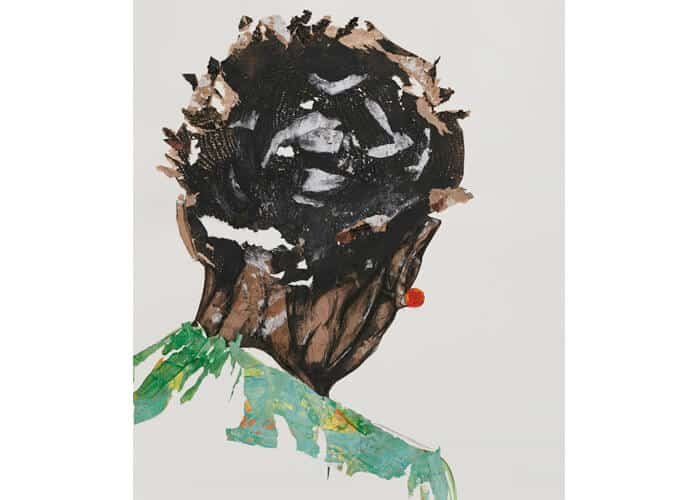
Art Africa speaks with Efia Mbidi, represented by Candice Berman Fine Art Gallery, about her experiences growing up in violent but important Sebokeng, her role as a black female artist, and how she uses tools to capture the essence of being a woman.
Efia Mbidi, “Beauty is for You to Understand Me”, 2016. Mixed media and collage, paper, 970 x 670 mm.
Altafrica: You were born in Sebokeng in southern Gauteng. This area was created by the apartheid regime and has a very violent and significant history. Do you think your upbringing has influenced your work?
EPHIA MMBIDI: I grew up in probably the worst environment in South Africa and was affected by the worst forms of racial violence. Sebokeng district, located in southern Gauteng province, has been overshadowed by the deepest tribal isolation between Zulu- and Sotho-speaking peoples. I experienced a lot of violence born out of tribal conflict, from notorious gangs to political unrest, all probably due to increases in municipal service fees.
This led to demonstrations, curfews, and school boycotts in the Vaal region in 1984 and 1985, as well as clashes between local communities, police, and city council members. The violence has also left thousands dead. Sebokeng was filled with smoke as the town hall and the houses of city council members and police were set on fire.
My father was a police officer. I remember an incident outside my parents’ house where a crowd was shouting chants about arson. Fortunately, they failed.
Nevertheless, as the years passed, people were able to unite and create a new society. As an artist, this era served as a source of inspiration. It is an expression of true human strength and the enduring spirit of Ubuntu.
We are also inspired by the city of Johannesburg. The more you observe it, the more you become fascinated by its mystery. On a cold winter’s day, you might see a woman in a flimsy dress waiting on a street corner to attract potential “customers”. And on the other side of the road, you might see a woman selling sweets on the street to put food on the table.
This kind of tenacity in the face of hardship is very impressive. But in my work you can also see my sense of humor, my vices, my love of color, and my femininity.
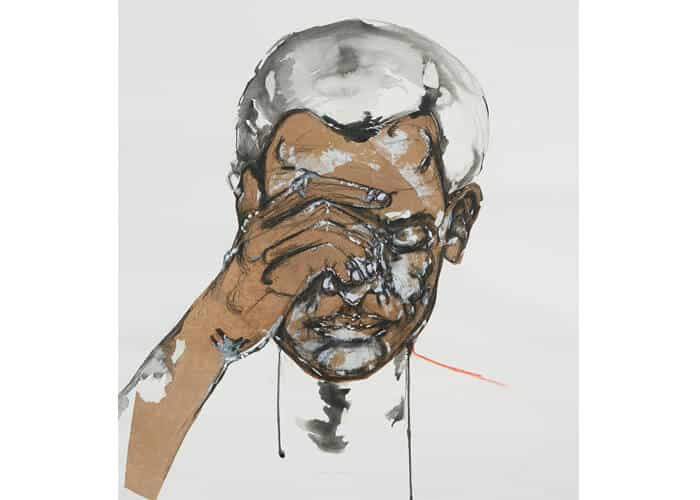 Efia Mbidi, Deep Thoughts, 2017. Mixed media and collage on paper, 675 x 575 mm.
In your artist statement, you state that “personal iconography is rich in references to social experience.” How do you depict these social experiences in your work? Are there any in particular that stand out above others?
When drawing a human face, what I have is to only look at the facial features and draw them. However, I believe that I am looking for something deeper and more personal about the human subject than simply depicting the superficial features of the human face. In other words, we are trying to convey the emotions that influence social movements in a rich and interesting way.
I tried to find a real connection between the facial expressions I was portraying and the inner feelings of the subject I was trying to portray. We believe that we can learn about social issues from both facial emotions and visual perception.
I have experienced loss, conflict, and deep suffering. I believe that the pain and sadness I have endured has challenged the core of who I am and that I have lost my way somewhere along the way. As I transitioned from adulthood to motherhood, from marriage to divorce, I found myself questioning my identity as a woman. I also questioned my role as a woman in society and how “woman” and femininity have been shaped by my culture.
Throughout the painting process, my work and exploration is to create more expressive works of art, aiming to reveal and capture my essence as a woman. For me, it comes from self-acceptance and awareness of my deeper emotions.
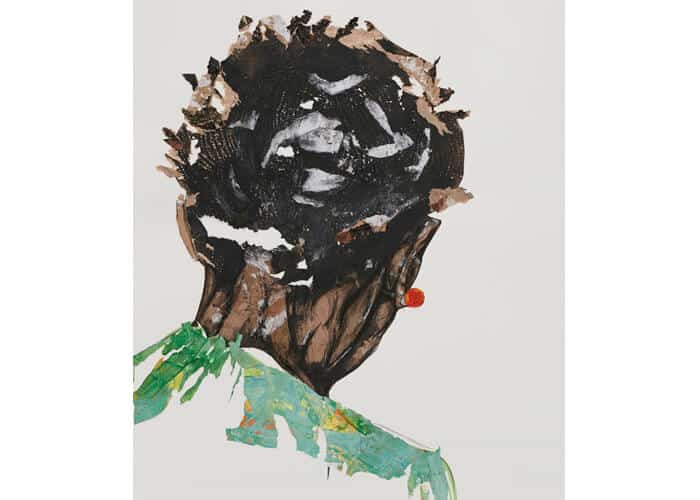 Efia Mbidi, me, 2016. Mixed media and collage on paper, 765 x 560 mm.
You have used textured materials, particularly tooled mixed media cardboard, to create portraits that capture the essence of what it means to be a woman. What is the symbolic significance of working on surfaces with tools, and how does it relate to notions of female construction, particularly in the South African context?
This is a very interesting question. If we look at the meaning of a tool from a symbolic point of view, it is because it is a physical item that can be used to achieve a goal. I really enjoyed using this tool, especially finding that it allows me to build portraits in my own way. Initially, this was just an experiment and not something I consciously discovered.
The relationship in terms of feminine constructs in the South African context would be, for me, “mosadi o twala tipa ka bogalen”. This literally means “a woman can hold a knife with the sharp side.” Revolutions happen when women are passionate about an issue, despite the many challenges that come with being a woman.
You have recently started collecting images and portraits of human heads from books, as well as using portraits of friends and family. Did this change in the source material have any impact on your work?
Use the new portrait as a reference. This is something I used to do a lot when I was a student, and I feel it’s very personal. I can relate to the emotions of these portraits in a more intimate way.
Finally, you have exhibited in galleries across South Africa. Do you have any hopes of exhibiting across the African continent or even abroad?
We will be exhibiting at the Art Expo to be held in New York this April. Yes, I am looking forward to more opportunities to grow as an artist and expand my work internationally.
