


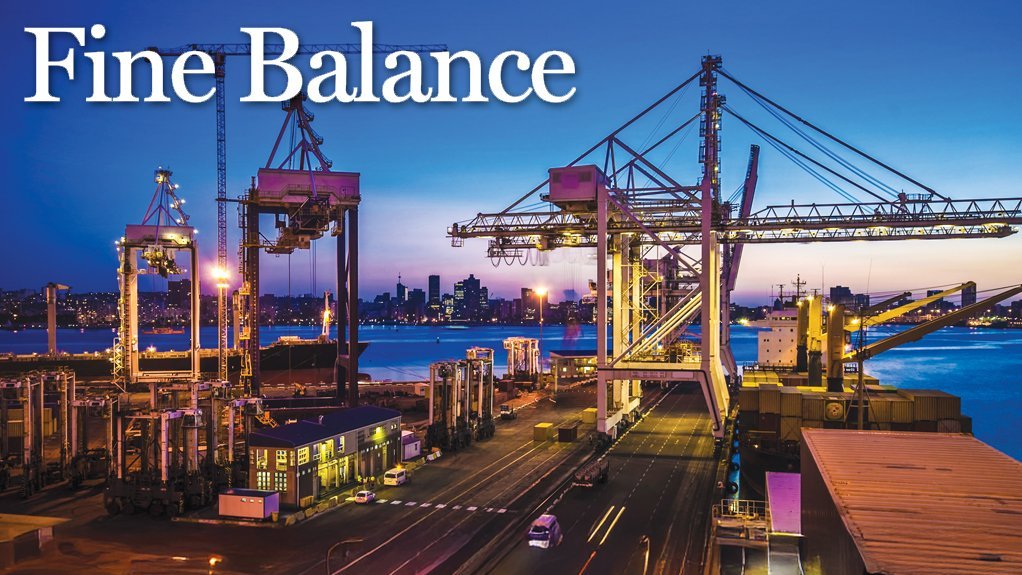
With state-owned freight logistics group Transnet turning to the market for investment in rail and port infrastructure, and the Department of Transport (DoT) introducing a range of reforms to enable private sector participation (PSP) in South Africa’s logistics system, questions have been raised about the risks of such involvement, particularly with regard to private sector transformation efforts.
In a recent transportation-focused webinar hosted by Creamer Media, Mark Evans, energy and natural resources partner at consultancy Oliver Wyman, said active efforts by the Department of State and Transnet to understand how the private sector wants to help have changed the landscape of logistics networks and how they operate.
“However, many uncertainties remain regarding the complexity of such an initiative and the regulatory, safety and practicality surrounding ensuring the success of PSP in the logistics sector,” he added.
State-owned companies recognize that they cannot rebuild infrastructure such as Transnet’s freight network on their own, nor can the government take on their losses indefinitely.
Mr Evans pointed out that Transnet’s recently issued request for proposals was not just a procurement exercise, but a redesign of national logistics that would introduce competition into an area that had been monopolized for many years.
He cited three global examples of how rail networks can be restructured and trust restored when governments involve private sector partners, share risks fairly and enforce transparent performance.
In Mexico, for example, 63% of cargo is transported by rail through dedicated goods corridors that operate on a concessional model.
South Africa has existing viable examples of PSPs, such as the public-private partnership (PPP) between the government and Trans African Concessions, which operates the 570km long N4 toll road. PSP has also had early success in the power sector.
According to Evans, investors are intrigued when the rules are clear, obligations are defined and returns are predictable.
The government has made clear that ownership of the rail network and ports will remain in state hands, but their operational management and capital participation are subject to debate.
In this respect, Mr. Evans believes that consortia are more effective than single players, as various stakeholders, such as funders, manufacturers, miners, manufacturers, and logistics experts, need to make important contributions.
Private sector involvement must be structured in such a way that efficiency gains do not come at the expense of accessibility or affordability. Because South Africa cannot afford to repeat a model that only serves investors while excluding communities and raising barriers for small businesses.
Therefore, Evans suggested that open access and fair toll obligations should be built into the contract to avoid the corridor becoming a “private highway” for private operators.
“International experience shows that it is possible to balance investor certainty with broader access (but only if regulators have the power and capacity to consistently enforce rules, set fair prices and hold operators accountable to full transparency).”
During the webinar, Jack Taylor, CEO of TATA Africa Holdings, acknowledged that the private sector has shown significant interest in rebuilding the country’s rail network and ports, backed by their expertise and technological capabilities.
He said businesses are aware of the impact that inefficiencies in the transport system have on exports and competitiveness.
TATA, an existing investor in South African terminals, believes that an effective PSP depends on a supportive legal framework, clear regulations and strong governance to ensure proper oversight. “We don’t need to reinvent the wheel. We can look at roads and learn from existing PPPs,” Taylor said.
He cited the example of how Mozambique’s PPP enabled South African companies to move goods to and export from neighboring countries.
cost issue
Commenting on the risks of allowing the private sector to operate public infrastructure, Mr Taylor said private companies would put capital into these projects and manage effective operations if they saw a profit.
He added that the costs of the lack of effective logistics solutions in South Africa are significant and the country stands to benefit from implementing effective solutions.
Some of the cost issues will naturally “smooth out” as the entire transport system value chain becomes more integrated and operates more efficiently, added Lilhans Mashaba, chief operating officer of the Railway Safety Regulator (RSR).
Mr Mashaba and Mr Taylor agreed that the introduction of competition in any market has a positive impact on prices for end users and customers, to which Siyabonga Mthembu, Managing Partner of BDO’s Nelson Mandela Bay office, responded by saying that allowing competition and eliminating monopoly models would address the problem of too high prices for services.
Many private companies will be willing to pay more to bring their products to market efficiently, even if there are unintended costs associated with the process. Because “as is often the case today, predictability of timelines and reliability of delivery are more important than risking product being delayed or not reaching the market,” added Leon Brewer, FedEx sales MD for sub-Saharan Africa.
Zen Dlamini, Sovereign and Public Sector Executive Director at Standard Bank, said that from a funder’s perspective, banks will ensure that the network is an enabler of efficient and successful locomotive operations, including through a favorable regulatory environment.
“If you’re making a loan and the rail operator isn’t thinking about efficiency or safety, that’s a risk.”
Commenting on whether private operators will ensure social development and responsible operation of the rail network, Mr Dlamini asserted that funding institutions such as Standard Bank will continue to hold private companies to account on environmental, social and governance factors.
Another factor that determines the success of PSP in logistics is infrastructure.
Nelson Mandela Bay has “worked hard” to improve its infrastructure to attract international investors and reduce operating costs. This includes energy, water and security infrastructure, which will enable an ecosystem to support private sector investment, Mthembu explained.
Mr Dlamini agreed, saying the biggest threat to South Africa’s infrastructure was the lack of security, which led to vandalism, extortion and sabotage.
For Brewer, a key requirement for mitigating PSP risks is consistency in cooperation to support the long-term competitiveness of the country’s exporters.
“Exporters need transparent enforcement, open channels for cooperation and consistent export rules,” he noted, adding that cooperation between stakeholders could also help address security issues on the rail network.
Mr Mashaba shared this view, saying cooperation could lead to skills transfer between the public and private sectors, which could benefit the transport and logistics value chain.
Government risk mitigation
To ensure the robust implementation of PSP in South Africa, the Department of Transport is leveraging global best practices to promote fair pricing, devise innovative financial models and strengthen tender processes, including complex tenders involving multinational companies.
Mthembu added that the biggest risks are around intent and trust. “South Africa is still run by politicians and they need to understand that the private sector is involved, not just for short-term profits, but to improve the country’s infrastructure and the way the economy works.”
Mr Mashaba emphasized that the government’s introduction of PSP in the logistics sector is a significant change and that regulatory approaches are actively evolving to adapt to this new reality. “We are working to overhaul the framework to make the permitting process more efficient, more agile and results-driven.”
RSR is also moving towards a more risk-based approach, focusing on high-risk operators that will be subject to more intensive scrutiny.
“For RSR, it is important to promote a culture of safety, not just compliance. We engage with new entrants to the rail network early in the planning stage and foster a culture of safety from the start,” Mashaba said.
He asserted that governments are beginning to realize how a more predictable and pragmatic regulatory framework that enables PSPs can revitalize and modernize the rail sector and, in turn, enable sustainable economic growth.
Taylor concluded that effective transport and logistics can benefit the broader economy and accelerate transformation on a broader scale, beyond a single sector.
