


The 1,028km Abidjan-Lagos Corridor Expressway project is scheduled to begin in 2026 and be completed in 2030, according to the African Development Bank (AfDB).
The bank revealed the dates during an online workshop held with project partners on November 22. AfDB is funding technical studies for highway projects with contributions from the EU, the ECOWAS Commission, and five corridor countries: Ivory Coast, Ghana, Togo, Benin, and Nigeria.
The Abidjan-Lagos Corridor Expressway Project will be a free, two-car superhighway connecting the economic capitals of the corridor countries. It will have four to six lanes, with a maximum of eight lanes in Lagos. Approximately 144km of the route passes through Ivory Coast, 520km through Ghana, 90km through Togo, 127km through Benin and 82km through Nigeria.
The project includes the construction of eight border crossings and 63 interchanges are also planned. Most of the works will be carried out in the form of public-private partnerships (PPPs), with 70,000 jobs expected to be created directly and indirectly during the road construction.
According to AfDB, the Abidjan-Lagos Expressway connects an urban population expected to reach 173 million people by 2050, linking West Africa’s most economically active and densely populated metropolitan areas, from Abidjan, Takoradi and Accra to Lomé, Cotonou, Porto-Novo and Lagos.
Source: ECOWAS Commission
“The Abidjan-Lagos Expressway will connect West Africa’s transport corridors (airports, roads and rail), linking inland regions of Mali, Burkina Faso and Niger to all eight ports in the corridor, as well as the Abidjan-Dakar-Praia Corridor,” said Liddy Ehouman, AfDB’s Chief Transport Economist and Project Manager. These ports handle 85% of Europe’s sea freight.
AfDB is also promoting the Spatial Development Initiative (SDI), a highway project aimed at transforming the corridor into an economic and industrial hub primarily through private sector investment.
A review workshop for the draft final report of the SDI study was held in mid-November. The research is being carried out by a consortium of Canada’s CPCS, South Africa’s Holland & Hausberger and Tunisia-based Comet Engineering.
The overall objective of this study is to identify and elucidate the unique and potential economic potential and commercial viability of economic and industrial value chain projects related to highways. Once implemented, these plans will also create trade and traffic volumes, increasing the viability of the highway.
The consultant team identified specific infrastructure interventions within the 200 km catchment area of the Abidjan-Lagos Corridor and considered three types of projects: economic anchors, strategic infrastructure, and densification and deepening plans.
Targeted industries include renewable energy, manufacturing, transportation and logistics, oil and gas, agriculture and agro-industry, information and communication technology (ICT), tourism, mining, and special economic zones (SEZs).
Major catalytic anchor projects identified for the expressway include the Remo Economic and Industrial Cluster in Nigeria, the Gros Digbe Industrial Zone (GDIZ) in Benin, the Adetikope Industrial Zone Cluster in Togo, the Greater Kumasi Industrial City in Ghana, and the PK 24 Industrial Hub in Ivory Coast.
“This economic corridor approach naturally overlaps with large-scale urban development,” said Mike Sarau, AfDB’s director of infrastructure and urban development.
“It will support the growth of key economic hubs and improve connectivity between metropolitan centres, secondary cities and rural areas in the five countries. The Bank has launched the Enabling Innovative Industrialization (SDI) along highways to stimulate growth in key economic clusters.”
Projects were identified and shortlisted according to strict criteria, including contribution to regional integration, financial, economic, social and environmental legitimacy, and readiness for implementation. Synergies with national master plans and policies, as well as forward and backward linkages, were considered.
At the end of the validation workshop, the Corridor Investment Plan will be finalized, comprising 26 project clusters and 120 deepening and densification projects, including 78 shortlisted schemes, for a total of 206 projects. Of this total, 27 schemes are ready for investment, with an estimated potential investment of US$6.8 billion.
“Our ultimate goal is to ensure that the corridor and the economic activities developed along it contribute to the ECOWAS regional integration agenda,” said Chris Appiah, Director of Transport at the ECOWAS Commission. “This is an integration project and once implemented, it will help us achieve the economic integration we want in the region.”
The Commission and the Corridor States are expected to receive the final design report, financial and implementation strategy, tender documents and all related documents for the Abidjan-Lagos expressway by mid-December.
Following this, the Commission will undertake investor roundtables and roadshows to secure the over US$12 billion in capital investment required to construct the supernational highway. In 2021, a potential investment of US$15.6 billion was pledged to the plan by various private and institutional stakeholders.
Ivory Coast will host the Abidjan-Lagos Corridor Highway Management Authority (ALCoMA), a supranational agency tasked with constructing, managing and operating the corridor on behalf of Benin, Ivory Coast, Ghana, Nigeria and Togo. The institutional arrangements for operating the authority are already being supervised.
Additionally, in June the ECOWAS Commission held a technical review of the draft interim report on trade and transport facilitation studies for highway projects. The aim is to develop a framework that allows the corridor to operate under a single borderless customs system. This includes a corridor-wide automated third-party insurance scheme for vehicles crossing borders called the ECOWAS Brown Card.
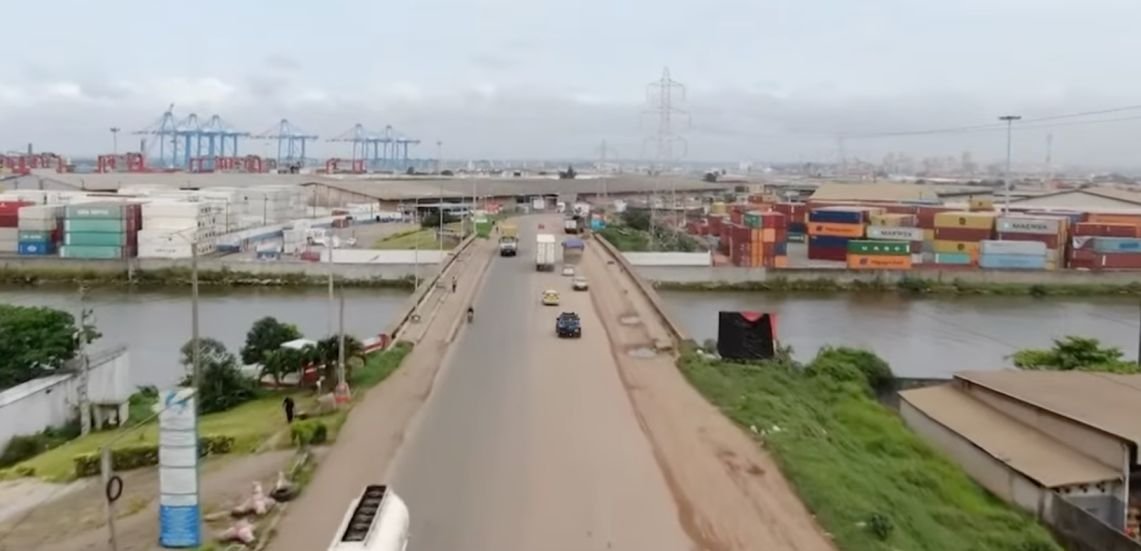
Top photo: Port Road (Source: Facebook@AfDB)
