


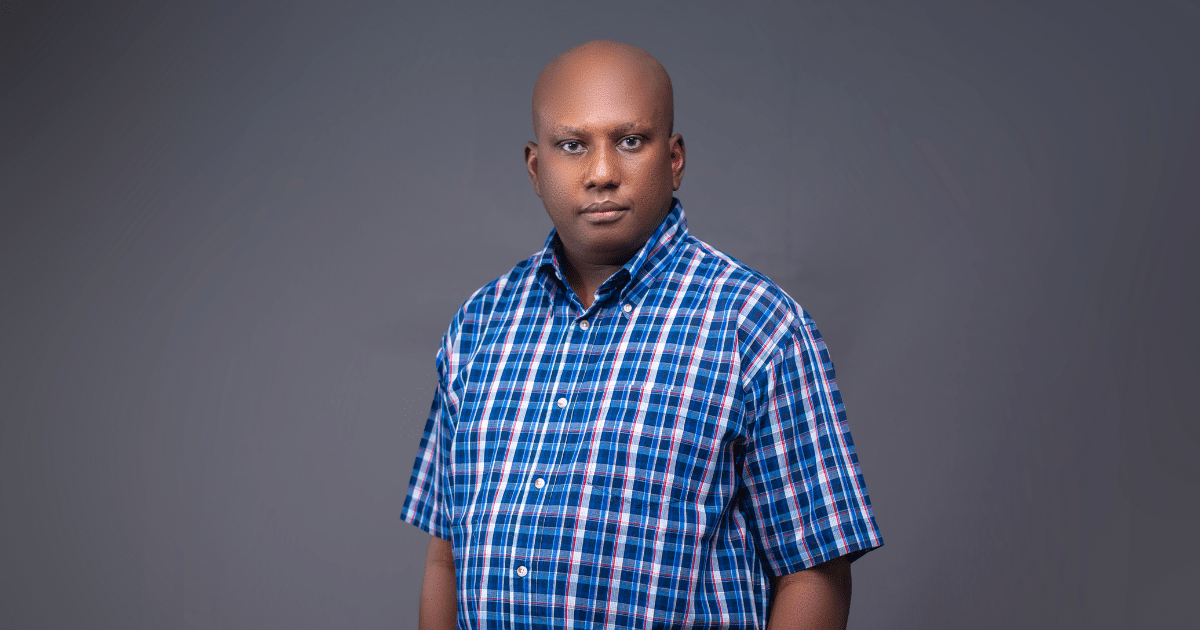
After losing a parent, Bukal Mamadou sought solace in writing poetry, and by the time he discovered the AI platform, he was releasing songs without even knowing how to sing them.
Mamadou is currently juggling his full-time job as a chief engineer at the University of Maiduguri while also releasing other songs on streaming platforms through an AI artist called BukarSkywalker.
In this edition of After Hours, Mamadou talks about her journey from studying electrical engineering to writing poetry and now managing AI artists.
Early interactions with technology
My first experience with technology was in 1989 at my uncle’s house in Lagos. I had just enrolled at King’s College in Lagos and was staying with his family for a few days before school resumed. He had a PC in his study, and one afternoon my cousin and I sneaked over to look at it.
When I turned it on, all I saw was MS-DOS, a black screen with a blinking cursor. I typed in “What’s your name?” The computer responded, “Incorrect command or file name.” I tried it again. “How old are you?” Same response. That was very disappointing.
From the movies I watched as a child, I thought computers were intelligent and capable of conversation. I thought they would talk to me the same way ChatGPT does now. Instead, we realized that computers only become smarter if we learn how to talk to them.
By the early 1990s, I had already learned BASIC programming in secondary school. Later, my father brought back the Sinclair ZX Spectrum from his office at the University of Maiduguri, and it was damaged due to the voltage difference, but I studied the manual and memorized it.
After secondary education, a gap year was usually taken before entering a higher education institution. So instead of waiting idly for university admission, I enrolled in a computer diploma program.
That was in 1994, long before Microsoft Office. So I was using WordPerfect, Lotus 1-2-3, and dBase.
From there I studied Electrical and Electronics Engineering and then completed my PGD and MSc in Software Engineering. Currently, I am working as Chief Engineer and Head of Computer Based Testing (CBT) Department at the University of Maiduguri ICT Center where I oversee system, network and computer based testing.
From poetry to music production
Unlike technology, I never thought that writing would define me. I have always been a science student. I loved numbers, logic, and analytical thinking, so English was one of my least favorite subjects.
Things changed when my mother passed away in my early twenties. I needed an outlet, something to help me process my grief, and writing provided that outlet.
I started writing poetry not because I wanted to be a writer, but because it was therapeutic. Initially, the poem was meant to honor my mother. Over time, the themes expanded to include spirituality, purpose, and how to live in the world. I completed the manuscript by 2000, but published it in 2011. I waited because I felt I was too young to speak authoritatively about life.
Around the same time, music began to influence my writing. I listened to everything from R&B to country to gospel to hip-hop. That’s what I think of as the Golden Age of R&B: Boyz II Men, New Edition, Babyface.
I became fascinated with songwriting and started writing lyrics in different styles. I wasn’t a musician, so I couldn’t play the keyboard or guitar, but I could write, so the lyrics became an extension of my poetry.
At one point I tried to turn my lyrics into an actual song. I reached out to musicians overseas and one of my songs, Love Comes, was recorded in Nashville with live musicians and vocalists.
But the process was unsustainable. It can cost between $300 and $500 to record a song, which is a huge sum in naira. To make matters worse, there was no guarantee of monetization. Some studios have reused the beats, making the songs unusable on streaming platforms.
Although I had the language, I realized I didn’t have the resources to pursue traditional music production long term.
Leveraging technology
Things changed when I discovered generative AI music platforms like Suno.
With AI, you can input lyrics, define genre and vocal style, and generate complete songs, vocals, instrumentals, and soundscapes without ever setting foot in a studio. I could iterate until I got exactly what I wanted. With a professional subscription, you also owned the commercial rights to your music.
In December 2022, I uploaded Love Comes to a streaming platform using the name BukarSkywalker. This is a virtual artist I created to represent my songwriting, not my physical self.
My wife and I put up all the money. We are both civil servants. We didn’t have any investors because we didn’t want to lose creative control or dilute our message.
Globally, AI music is no longer experimental. It’s becoming mainstream. Virtual artists like Xania Monet and I’m Oliver have signed deals with major media companies. Zania Mone reportedly received a $3 million contract. The Grammy Awards have already awarded AI-powered music, including a Beatles song recreated using AI-enhanced vocals.
Major labels like Sony, Universal, and Warner have accepted that AI is here to stay. Instead of fighting it, they license their likenesses, voices, and catalogs for ethical remixing and monetization.
For me, this is a validation of the direction I have chosen. We knew early on that streaming alone couldn’t sustain the project, so we expanded.
We’ve made AI-generated songs and lyrics available for licensing on platforms like Songbay. Anyone can license my work for commercial use and I get songwriter royalties. I also sell poetry books and manage the Linktree hub for music, writing, licensing, and blogging content.
What surprised me most is that there is little awareness of AI music in Africa. These tools already support African languages and styles. You can generate songs all on your phone, without studio time or expensive equipment. All songs were created using a smartphone.
The problem isn’t access. It’s about consciousness and thinking. We’ve seen this before. Telecommunications, fintech and even Afrobeats, once rejected, are now being embraced globally. Someone has to start.
My daily life with technology
Technology is my daily routine. As a university computer engineer, I troubleshoot systems, manage networks, proctor computer-based exams, and am immersed in digital tools.
WhatsApp and Gmail are the apps I use the most. I also read the newsletter regularly. Because when it comes to tech, finance, and startup stuff like Techpoint Digest, the learning never ends.
My biggest challenge is not the technology itself, but its location. I am based in Maiduguri. There’s no real technology ecosystem here. There are no scrum meetups. There are no Jira boards. There is no Slack community.
I learned a lot of tools online and got to join Lagos-based communities like AltSchool Africa. I enrolled in 2022, and at that time I was in my 40s and probably the oldest of my peers.
At first I wondered who would teach software engineering? But AltSchool completely changed my perspective. I saw a Nigerian engineer based in Lagos able to compete with anyone in the world. That experience convinced me that there is no shortage of talent in Africa. What we often lack is belief, ecosystem, and infrastructure.
If I could build a technology product right now, it would be an AI music generator specifically for Afro Gospel.
I would buy the AfroGospelAI domain and build a niche tool like Suno that focuses solely on African gospel sounds. I use an API like Eleven Labs to power it.
The future of technology in Africa
I am bullish about the future of technology in Africa. I have seen Nigerian engineers competing globally. I have seen young people from Lagos get international jobs without leaving the country.
I believe that in the next five to 10 years, ICT, not oil, will be Nigeria’s most valuable export. If we continue to innovate, invest in skills and embrace innovation, Africa will become more than just a consumer of technology. We build it, we export it and we shape its future.
And for me, BukarSkywalker is simply a way to contribute to that future.
