


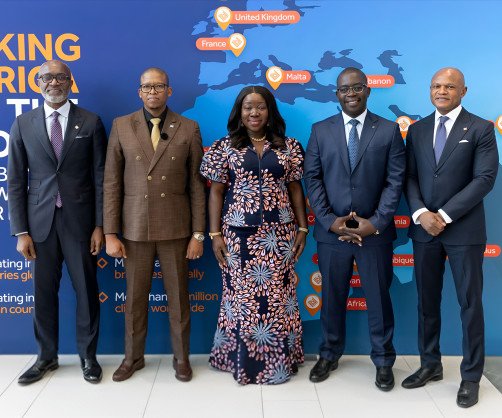
Roosevelt Ogbonna, Managing Director and Chief Executive Officer of Access Bank Plc (www.AccessBankPlc.com), called for increased cooperation between policymakers, financiers and businesses to accelerate intra-African trade and unlock the continent’s economic potential.
Mr. Ogbonna made this call at the Access Bank African Trade Conference (ATC 2026) in South Africa, saying Africa needs to address the structural barriers that continue to limit the growth of intracontinental commerce despite its huge market opportunities.
In his opening remarks, the Access Bank chief said the conference was convened to continue the dialogue begun at the first conference in 2025 on how Africa can increase intra-continent trade while strengthening its participation in global markets.
He noted that Africa’s share in global trade remains relatively small, stressing that fragmented trade corridors and structural bottlenecks continue to hinder trade growth across the continent.
He said: “The reality is that Africa still controls a small portion of global trade. Corridors remain fragmented, more aspirational than functional, and too many small and medium-sized businesses wishing to trade across Africa remain constrained.”
Mr. Ogbonna further explained that at last year’s meeting, stakeholders agreed on three key priorities in transforming Africa’s trade landscape. His priorities include (i) breaking down silos between policymakers, financial institutions, and businesses; (ii) building a trade ecosystem based on reliable data and analytics; and (iii) developing systems that support both large and small businesses looking to expand across borders.
He noted that the 2026 edition of the conference is not a new start, but a continuation of efforts to foster meaningful progress in intra-African trade. He said some progress had been recorded across key sectors of the economy since the last meeting.
“We are seeing value chains emerge across agriculture, manufacturing and services, and we are seeing African brands transcending borders and building a global presence,” he said.
Mr Ogbonna also noted the increasing role of technology platforms in reducing friction in areas such as payments, logistics and market access. However, he acknowledged that gains remain uneven across the continent, with progress concentrated in a few markets and specific trade corridors.
African Development Bank (AfDB) Southern Africa Director Kennedy Mbekeani spoke of the need to strengthen infrastructure financing for growing intra-African trade and called for increased mobilization of private capital to finance the critical infrastructure needed to realize Africa’s full potential for trade integration.
“Mobilizing private capital remains important as many African governments are constrained by limited fiscal space and oversized balance sheets. Mobilizing capital, especially private capital, is something we need to work on,” Mbekeani said.
During the conference’s ministerial panel discussion, Zambia’s Minister of Commerce and Industry, Chipoka Mulenga, set out African governments’ perspectives on promoting intra-African trade, stating that policy coordination among African countries is critical to unlocking the continent’s trade potential.
“Policies are very important in putting something together. Policies have to be consistent, resilient and coherent. If we need to enhance intra-African trade, we need to intentionally develop policies that speak the same language between our two countries. We need to leverage our comparative advantages rather than compete with each other,” Mulenga said.
Also speaking during the session was Elizabeth Agyare, Ghana’s Minister of Trade, Agribusiness and Industry, who noted that Africa does not lack policy frameworks, but rather struggles with harmonized implementation.
“Africa is not without policies. We already have many. Our challenge is to implement these policies in a harmonious manner. That is what we must focus on to make trade work effectively across the continent,” she asserted.
Mr. Adjale further stressed that countries must actively adopt frameworks of compromise and mutual recognition to facilitate cross-border trade.
“No progress will be made if we insist on validating every product individually. By harmonizing standards and recognizing each other’s certification processes, we will be able to trade more efficiently,” she added.
In a similar vein, Botswana’s Trade and Entrepreneurship Minister Tiroeaone Ntsima said African governments need to focus on creating an enabling environment for businesses and investors to foster economic growth.
“Government today is different than it was in the 1960s, when everything was run by the government. Our role now is to create an environment where businesses and investors can thrive.”
Ntsima added that Botswana is re-establishing itself as a major trade corridor in the region. “While we once called ourselves a landlocked country, we now consider ourselves landlocked. Creating corridors to connect markets across the continent will open up new opportunities for trade and economic growth,” he said.
In his final note, the Access Bank chief urged stakeholders across Africa to go beyond dialogue and take concrete steps to strengthen trade relations between African countries, stressing that Africa’s economic transformation will depend largely on the willingness of businesses and institutions to work together more effectively.
“This conference must not remain just a chat; it must become the birthplace of a movement that will contribute to the transformation of intra-African trade,” he urged.
Distributed by APO Group on behalf of Access Bank PLC.
