


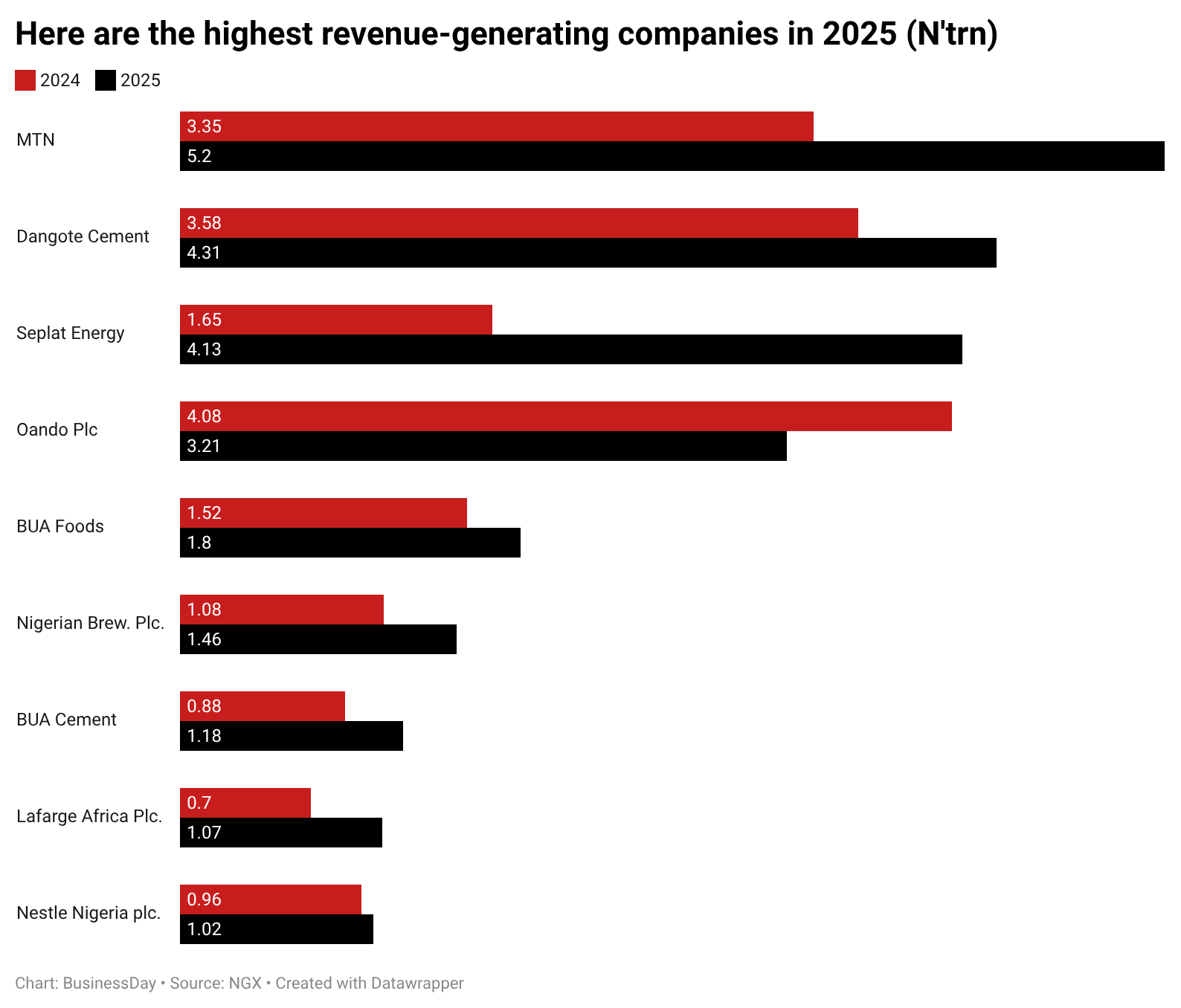
Nigeria’s trillino profit club expands further in 2025 as BUA Cement, Lafarge Africa and Nestlé Nigeria Ltd cross the N1 trillion mark, joining the league of giants that are benefiting from increased macroeconomic stability, easing inflationary pressures and price adjustment.
According to the audited financial statements of the leading listed company, BUA Cement’s revenue increased from N876 billion in 2024 to N1.18 trillion in 2025. Lafarge Africa recorded N1.7 trillion, up from N696 billion a year ago. Nestlé increased from N958 billion to N1.2 trillion.
The three companies are now alongside industry leaders such as MTN Nigeria, which ranks first with revenue of N5.2 trillion, followed by Dangote Cement with N4.31 trillion, reaffirming its position as Africa’s largest cement producer. Seplat Energy also remained a major player, posting N4.13 trillion, supported by increased crude oil production and improved prices.
In the fast-moving consumer goods sector, BUA Foods continued its impressive growth trajectory with revenue from N1.52 trillion to N1.8 trillion, driven by strong demand across its food product lines. Similarly, Nigeria Breweries Limited reported N1.46 trillion, reflecting price-led growth amid persistent cost pressures.
Despite a slight decline in revenue, Oando Plc remained within the trillion naira bracket, posting 3.21 trillion naira in 2025 compared to 4.8 trillion naira in 2024 as it adapted to changes in its operations and pricing structure.
The expansion of Trillion Aira’s revenue base highlights the adaptability of large Nigerian companies in weathering economic headwinds, particularly the currency fluctuations and rising production costs that characterized much of 2024.
Also read: Providus meets CBN recapitalization requirements, expands base to 65 billion naira
Nigeria’s economy has rebounded from the great volatility and unpredictability that dominated 2023 and 2024 after President Bola Tinubu abolished expensive and unsustainable fuel subsidies and unified opaque exchange rates. The move initially caused prices to soar, causing the naira to plummet by more than 70%.
These policies increased input costs for companies, and many companies suffered unprecedented foreign exchange losses. But now the tide is turning. The naira maintained the rarest stability in years in 2025, with pressure on earnings slowing. The local currency rose 7.5%, the first positive gain in more than a decade.
Headline inflation has also fallen from multi-year highs, thanks to rebasing and new methods to reduce inflation. The National Bureau of Statistics (NBS) also revealed that Nigeria’s real GDP growth rate increased by 3.87% in 2025 from 3.38% in 2024.
The latest print edition shows Nigeria’s annual performance is its strongest since 2022, further extending its recovery from the 6.96 per cent contraction caused by the pandemic in 2020. Growth recovered to 0.95 percent in 2021, accelerated to 4.32 percent in 2022, slowed to 3.04 percent in 2023, but has now grown for the second consecutive year.
Similarly, the Consumer Price Index also declined from 15.10% in January 2026 to 15.06% in February 2026.
The month-on-month headline inflation rate rose to 2.01% from -2.88% in the previous month.
Analysts note that much of the revenue growth recorded across sectors was driven by a combination of pricing strategy and gradual naira stability, which is helping companies better plan and control costs.
Beyond revenue, profitability trends were mixed but improved significantly across key sectors. Dangote Cement recorded a profit of N1.02 trillion, joining MTN Nigeria, which posted a profit of N1.1 trillion, as the only companies to achieve a profit of N1 trillion in 2025.
Other companies such as BUA Cement, Lafarge Africa and BUA Foods also posted strong profit increases of 383 per cent, 173 per cent and 91 per cent respectively. Underpinned by improved margins and cost efficiencies.
Meanwhile, companies such as Nestlé Nigeria and Nigeria Breweries have returned to profitability after posting losses in 2024, suggesting a gradual recovery in the consumer goods sector.
The latest Purchasing Managers’ Index (PMI) survey revealed that Nigeria’s private sector returned to expansion in February as improved exchange rate stability eased inflationary pressures to a six-year low and supported robust business activity.
The composite PMI in February was 53.2, up from 49.7 in January, indicating new improvement in business conditions and marking the highest level in two months.
Muyiwa Oni, Head of West Africa Equity Research at Stanbic IBTC Bank, said: “After the decline seen in January, Nigeria’s private sector has returned to growth, with the headline PMI settling at 53.2 points in February, up from 49.7 points in January.”
“The local currency appreciation played a role in supporting the softening of input and output prices in February, as the naira has remained consistently below 1,400 yen against the dollar since January 29,” he said.
Analysts say wars in the Middle East are causing further inflationary pressures, but continued currency stability and increased local content will help offset import inflation, allowing businesses to enjoy another record year.


