


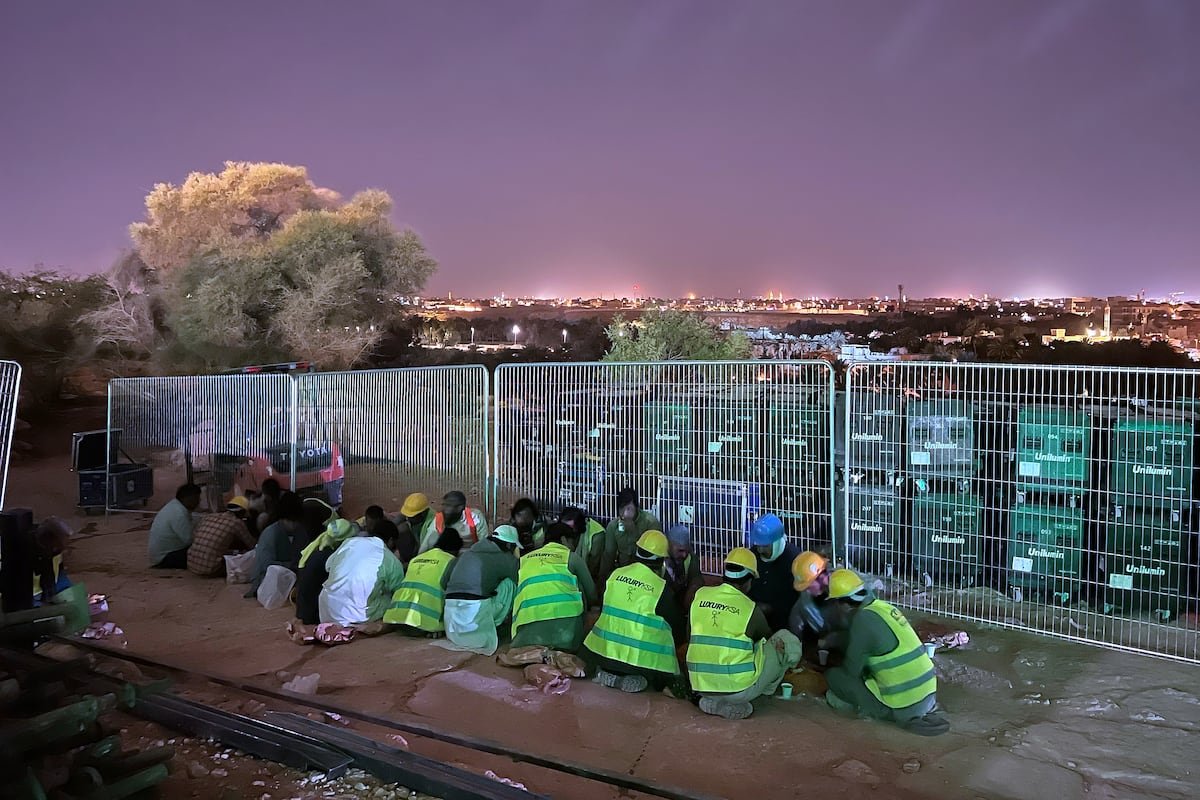
As sirens blare across Dubai, Melon tries not to think about leaving. She fears missiles, but this Ethiopian domestic worker knows exactly why she stays here. Her salary will pay her daughter’s school fees and feed the entire family back in Addis Ababa. For her, leaving the Gulf is not an option because of the barrage of Iranian missiles launched in response to attacks by the United States and Israel.
“I’m not thinking about quitting. Whatever happens, happens,” Mellon shrugged. She asked that her real name be withheld for safety reasons. “This situation affects not only me, but all of us. My daughter has to go to school. I pray for peace, because peace here means survival back home.”
Meron is one of about 5 million African immigrants living in the Gulf Cooperation Council (GCC) countries: Saudi Arabia, the United Arab Emirates, Qatar, Kuwait, Bahrain and Oman. These people come from countries such as Kenya, Uganda, Ghana and Ethiopia, and make a living in construction, domestic work, hospitality, logistics and security services.
I pray for peace, because peace here means survival at home
melon, domestic worker
But now, with rising geopolitical tensions related to the Iran-US conflict, they have deep concerns about their ability to earn and send money home. According to United Nations data, more than 200 million people across the African continent benefit from remittances. With this money, they pay their bills, buy food, receive medical treatment, and cover other expenses. Remittances account for almost 6% of the continent’s GDP. And in countries such as The Gambia and Lesotho, it exceeds 20%. In some cases, remittances from abroad can generate more income than Official Development Assistance (ODA).
In 2024, African countries received more than $95.3 billion in remittances from the diaspora, making these remittances one of the continent’s largest sources of external financing. According to Africa Finance Corporation’s “African Infrastructure Status Report 2025,” Nigeria, Egypt, and Morocco are the main recipients.
For Kenyan taxi drivers on the UAE’s busy highways, geopolitical tensions are secondary to their daily wages. He has lived in Dubai for 10 years and says he has no intention of backing down as his family is completely dependent on his income. “I’m not scared. I send money to my mother, sister, and brother every month,” he explains. “No matter what happens here, I will support them. I work every day. I will not stop sending money.”
For many African households, the question is whether remittances are here to stay: a simple but important question. Well, so far, and according to at least 12 workers interviewed by EL PAÍS, the money continues to flow thanks to the plethora of apps and digital payment services available in the GCC countries. But there are growing concerns that the war could last even longer.
The grueling work schedules of these immigrants highlight a clear economic paradox. Remittance flows may even increase further in the early stages of the crisis. Hany Abu Akre, market analyst at XTB MENA, points out that the Gulf labor market has undergone significant changes in recent years. In the Gulf, particularly in the UAE and Qatar, there has been a widespread increase in the participation of African workers, particularly those from Kenya and Uganda.
Abu Akre said many of these workers often work abroad primarily to send money to their families. He points out that this trend is partly due to currency depreciation in some African economies in the face of the global crisis, particularly a strong US dollar.
The analyst added that direct money transfers through electronic payment apps widely used in Gulf countries are also becoming increasingly important for migrant families in their home countries as commodity prices rise. Many of these economies rely heavily on imports, increasing costs for consumers. This trend was further exacerbated by soaring oil prices, which exceeded $100 per barrel.
Economists believe the real risk lies in job security, not disruption to the remittance system. When wars affect local economies, delaying construction projects and forcing companies to cut costs, immigrant workers can be among the first to feel the effects.
Financial services analyst Amro Zakaria said the latest available data (2024 and 2025) shows that remittances from Kenyan workers in the Gulf account for about 10% of all funds sent home by Kenyans abroad, equivalent to about $497 million. Total remittances in Uganda are approximately $1.6 billion, supported by approximately 300,000 Ugandan workers, primarily employed in Gulf countries. As for Ethiopia, official statistics put remittances from workers in the Gulf at around $600 million, although the actual amount is likely to be higher as data is limited and incomplete.
According to Zakaria, the threat is not immediate but structural. As oil prices fluctuate, shipping routes become unclear and the number of tourists decreases. Companies may choose to reduce employment or reduce working hours. Such adjustments would directly impact immigrant workers whose income supports families thousands of miles away, he added.
Zakaria notes that if the current crisis worsens, the economic impact could be similar to the disruption seen during the COVID-19 pandemic. But he argues there is enough liquidity in the Gulf, particularly the UAE, to cushion any potential disruption.
The African Union and leaders across the continent are growing concerned about the escalating conflict between the United States and Iran, warning that the crisis could have serious economic and security implications. Rising fuel costs, disrupted trade routes, including the closure of the Strait of Hormuz, and volatile financial markets have already hit several African economies hard. South African President Cyril Ramaphosa said the situation was already straining Africa’s supply chains and pushing up energy prices. He also warned that import-dependent economies across the continent were particularly vulnerable, and urged all parties to pursue dialogue, noting that diplomacy remained the only sustainable path to ending the conflict.
In Kenya, President William Ruto condemned the escalating hostilities and warned that the regionalization of the conflict posed a serious threat to global peace and security. He called for urgent international intervention to ease tensions.
This article was published in collaboration with Egab, a platform that collaborates with journalists in the Middle East and Africa.
Sign up for our weekly newsletter and get more English news coverage from EL PAÍS USA Edition
