


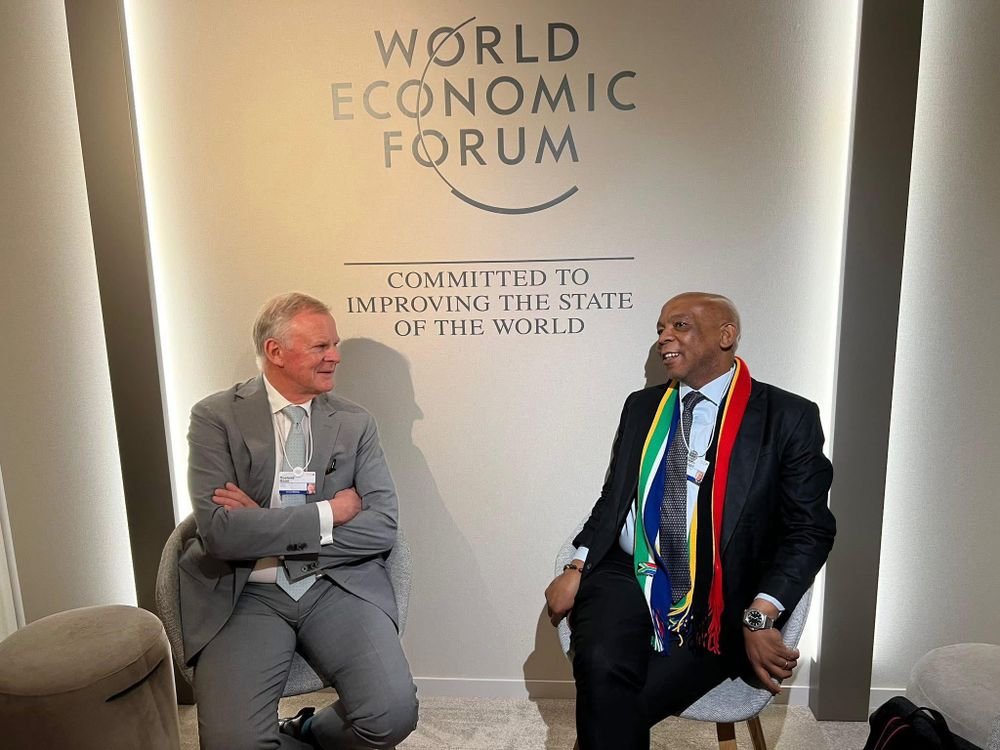
South Africa will not return with fresh sovereign financing from the World Economic Forum (WEF) in Davos, Power and Energy Minister Kgosiensho Ramogopa said on Thursday, as the government accelerates plans to inject private capital to finance the expansion of the country’s electricity grid.
Responding to concerns that international investment forums often result in new debt burdens for countries, Ramokopa said the government’s energy plan is clearly structured to avoid further pressure on public finances, relying instead on market participation and innovative financing instruments.
Central to this strategy is a planned 14,000 kilometer expansion and modernization of South Africa’s electricity transmission infrastructure, a key enabler to unlock new generation capacity and ease grid constraints that prevent investment in renewable energy.
Mr Ramokgopa said some of the transmission construction would be directly funded by state-owned companies such as Eskom’s transmission arm and the National Transmission Company of South Africa (NTCSA), but the bulk of the program would be delivered through private sector participation.
“We have announced a 14,000 kilometer expansion and modernization program in the transmission sector. It is important to remember that some of that transmission expansion is disproportionately financed by Eskom and NTCSA,” Ramokgopa said.
“A big part of that is due to market participation.”
The first phase of the program represents approximately 7.2% of the total deployment and has already been brought to market using a build-operate-transfer model. Under this structure, a private operator finances, constructs, and operates transmission assets before transferring them to the state.
“We had an incredible response,” Ramokopa said, adding that the number of bidders had been narrowed down to seven, three of whom will be selected as preferred bidders.
Importantly, Ramokgopa stressed that the government does not borrow money from international conferences such as Davos.
“I think the concerns are probably valid. I can come here with a powerful delegation, but I can never borrow money,” he said. “There is only one institution that can borrow money on behalf of the country, and that is the Treasury.”
Instead, Ramokgopa said the government is seeking equity participation, technical expertise and engineering capabilities from global companies, particularly large multinationals that have already demonstrated confidence in South Africa’s procurement processes.
“We met a number of companies who are keen to invest in transmission infrastructure and also participate as EPCs (engineering, procurement and construction),” he said.
“In fact, some of them have made bids and are participating in the study. It’s important that the big multinationals recognize that we have confidence in our procurement program and its integrity, so they will respond.”
“We don’t think we owe money in the form of loans, either to the Treasury or to ourselves. We’re not asking for money, at least on the energy side.”
Ramokgopa stressed that to further reduce fiscal risks, the government has introduced credit guarantee instruments to replace traditional sovereign guarantees, which have historically weighed heavily on national balance sheets.
Under this model, the country is expected to invest around $2 billion in the vehicle, with development finance institutions such as the Development Bank of South Africa (DBSA) and the International Finance Corporation (IFC) providing additional capital.
“Credit guarantee instruments act as sovereign guarantees,” Ramokgopa said. “However, we will not expose our finances to ongoing debt that would worsen our financial position.”
The minister also referred to questions about South Africa’s Just Energy Transition (JET) programme, supported by a group of international partners including Germany following the US withdrawal.
As chair of the inter-ministerial committee overseeing the JET Investment Plan, Ramokgopa said the central issue was not the availability of funds, but whether the funds were truly concessional.
“No matter what money we borrow, someone ultimately has to pay,” he says. “When money is expensive, you and I both pay for it through higher tariffs and taxes.”
He warned that underwriting financing at prices similar to commercial bank loans would undermine the government’s commitment to stabilizing electricity prices and protecting consumers.
“We’re not denying funding,” he said. “But it has to make sense. It has to be affordable. It can’t create new problems domestically.”
Ramokgopa acknowledged that some international partners were unhappy about the pace of funding, but said South Africa would not compromise fiscal sustainability or energy affordability.
“I need money,” he said. “But it must be cheap, concessional and in line with national goals.”
business report
