


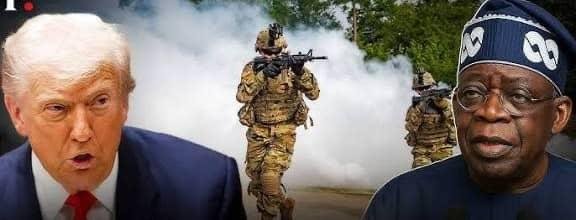
The U.S. military is increasing supplies and intelligence sharing with Nigeria as part of a broader U.S. strategy to work with Africa Command to target Islamic State-linked extremists across the country, Lt. Gen. John Brennan, deputy commander of U.S. Africa Command, said.
Brennan told AFP that the Pentagon maintains open communication with military regimes in the Sahel, including Burkina Faso, Niger and Mali, despite political upheavals that have strained relations with the West.
The increased cooperation with Abuja comes against the backdrop of diplomatic pressure from Washington over jihadist violence in Nigeria, but also as the US military has adopted what Brennan described as a “more aggressive” approach in pursuing Islamic State-related targets on the continent.
In an interview on the sidelines of the U.S.-Nigeria Security Conference in Nigeria’s capital last week, Brennan said that under President Donald Trump’s administration, “we’ve become more aggressive and we’re working with our partners to dynamically target threats, primarily ISIS.”
“From Somalia to Nigeria, the set of issues is connected. So we’re trying to break it down and give our partners the information they need,” he added.
“This is aimed at providing less restrictive equipment and capabilities to enable more partners and be more successful.”
Last week’s first U.S.-Nigeria joint working group meeting, held nearly a month after the United States announced a surprise attack on Islamic State-linked targets in northwestern Nigeria on Christmas Day, marked a significant increase in direct U.S. military involvement in the country’s security challenges.
But the expanded military cooperation unfolds amid diplomatic tensions over how Washington characterizes the nature of violence in Nigeria. The two militaries appear keen to strengthen cooperation in the wake of the joint attack, but diplomatic pressure from the Trump administration over the mass killing of Christians in Nigeria has cast a shadow on the partnership.
Abuja and independent analysts rejected the framing of Nigeria’s myriad overlapping conflicts, saying it has been used for years by the religious right in the United States and oversimplifies Africa’s most populous country’s complex security situation.
Blame-filled politics were on display at a joint working group meeting in Abuja, where Alison Hooker, the No. 3 US State Department official, urged the Nigerian government to “protect Christians” in a speech without mentioning Muslim casualties at the hands of militants.
Nigeria is almost evenly divided between the predominantly Muslim north and the Christian south. Although millions of people live peacefully side by side, religious and ethnic identity remain sensitive topics in a country that has experienced sectarian violence throughout its history.
Brennan told AFP that US intelligence support is not limited to protecting Christians.
He also said that in the wake of U.S. airstrikes in the northwestern state of Sokoto, future U.S. assistance would focus on sharing intelligence to support airstrikes in the region and in the northeast, where a jihadist insurgency by Boko Haram and its rival Islamic State West Africa Province has been intensifying since 2009.
The Islamic State West Africa Province, known by the acronym ISWAP, is “the group of greatest concern to us,” Brennan said.
Analysts have been tracking U.S. intelligence flights over Nigeria in recent months, but some question whether air support alone can effectively push back insurgents that thrive on widespread poverty and state collapse in the country’s rural areas.
Brennan said future cooperation between the United States and Nigeria will include “sharing and sharing all kinds of information, tactics, techniques, procedures, and being able to procure more equipment.”
Brennan said the first U.S. attack in December targeted militants associated with the Islamic State Sahel region, which typically operates in neighboring Niger. Analysts have expressed concern that ISSP is spreading from the Sahel to West African coastal countries such as Nigeria, raising concerns about the spread of jihadist violence southward.
Related article: Nigeria confirms US airstrikes, announces joint security cooperation will target ISWAP locations in northwest
However, the impact of these attacks is so far unknown, with local and international journalists unable to confirm any militant casualties. Asked about its effectiveness, Nigeria’s Information Minister Mohammed Idris said last week that it was “still a work in progress.”
In a major revelation about U.S. involvement in the broader Sahel region, Brennan said “we are still working” with the military-led governments of Burkina Faso, Mali and Niger, which have broken away from their West African neighbors and largely excluded Western powers in recent years.
Security cooperation has been curtailed since military coups toppled civilian governments in the three countries between 2020 and 2023. The junta has increasingly sought military aid from Russia and expelled French and American troops from its territory.
“We actually shared intelligence with some of them to attack major terrorist targets,” Brennan said. “While not official, we are still in discussions with our military partners in the Sahel.”
The revelations suggest that Washington maintains back-channel military-to-military contacts with the Sahel junta, driven by shared concerns about the spread of jihadist groups, despite divided public opinion and the withdrawal of U.S. troops from bases in the region.
Brennan also said the United States is not seeking to replace the base in Niger after its troops were removed by the ruling military junta following the July 2023 coup that ousted President Mohamed Bazoum.
“We are not in the market to create drone bases anywhere,” he said, referring to the closure of U.S. drone operations in Agadez, which was a key hub for U.S. surveillance and strike operations across the Sahel.
“We are much more focused on delivering capacity in the right place at the right time and then exiting. We are not looking for long-term presence in West African countries.”
The shift in U.S. military strategy reflects a recalibration of U.S. engagement in West Africa and the Sahel region, moving away from large permanent bases toward more flexible, partner-focused operations that rely on information sharing and allow local forces to conduct independent attacks against jihadist targets.
The withdrawal from Niger was a significant setback for U.S. counterterrorism operations in the Sahel region, where the U.S. military has invested heavily in building facilities and training local forces. The loss of the Agadez drone base, which cost more than $100 million to build, deprives Washington of a critical surveillance platform for monitoring extremist movements across the region.
But the increased attention to Nigeria, which shares borders with Niger, Chad, and Cameroon and faces multiple security threats from jihadist groups, banditry, and separatist movements, suggests that Washington views Africa’s largest economy and most populous country as a key partner in counterterrorism efforts on the continent.
Nigeria’s security challenges are complex and multifaceted. In the northeast, insurgency by Boko Haram and ISWAP has killed tens of thousands of people and displaced millions since 2009. In the northwestern and north-central regions, armed bandit groups have terrorized rural areas, kidnapping thousands of people for ransom and displacing entire villages. In the southeast, separatist agitation occasionally became violent.
The Nigerian military, despite being one of Africa’s largest and best-equipped militaries, struggles to contain these threats, hampered by corruption, low morale, inadequate equipment, and the enormity of the country’s security challenges across its vast territory.
The U.S.-Nigerian security partnership has had its ups and downs over the years, often complicated by human rights concerns over the actions of Nigerian security forces and U.S. military sales restrictions imposed under the Leahy Act, which prohibits U.S. aid to foreign military units credibly accused of serious human rights abuses.
Brennan’s comments that the United States is now providing equipment and capabilities “with fewer restrictions” suggested that some of these constraints may be eased under the Trump administration, which has prioritized aggressive counterterrorism operations over human rights considerations in its foreign policy.
