


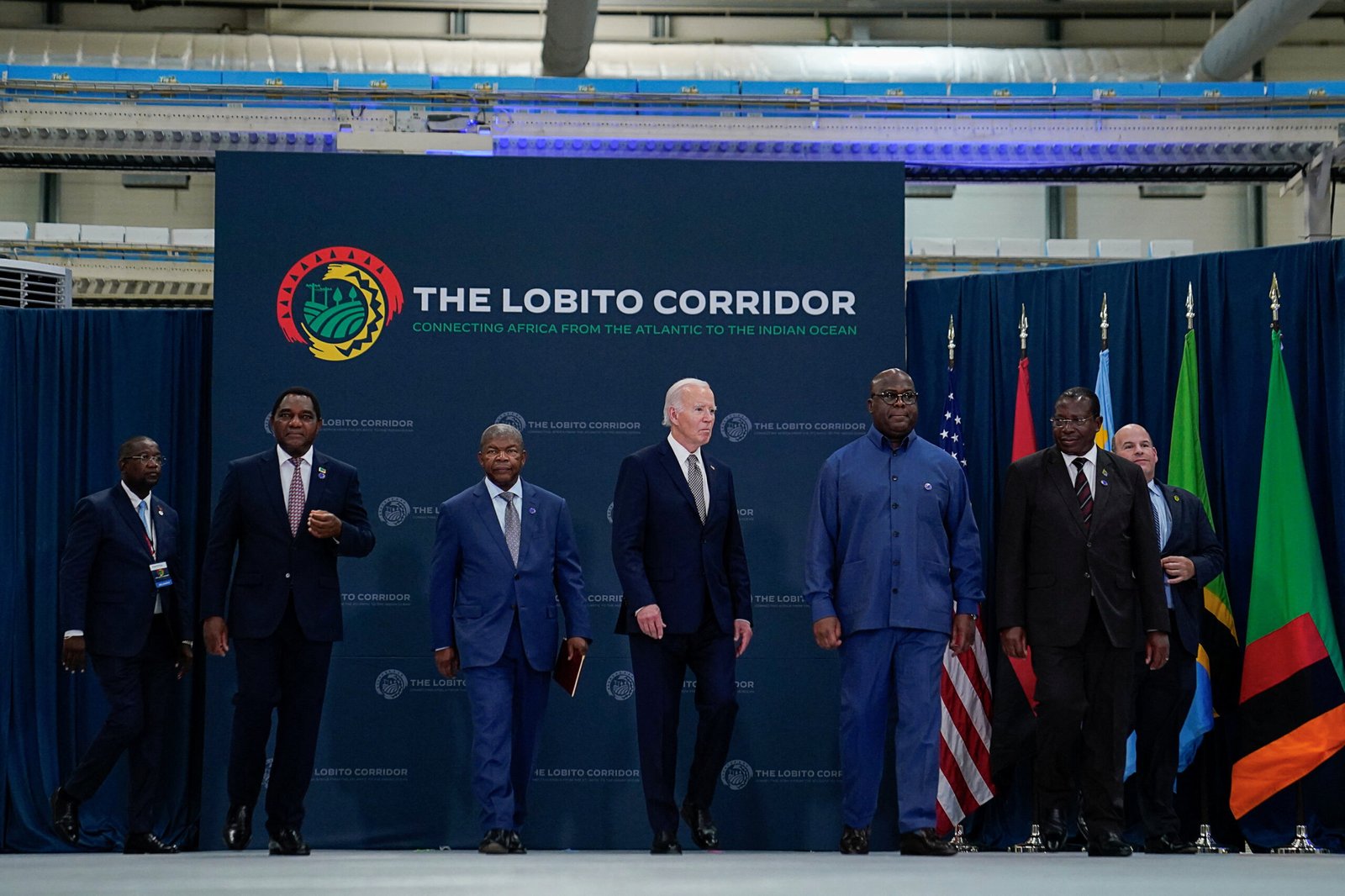
During a visit to Angola in early December, US President Joe Biden pledged an additional $600 million to the Lobito Corridor Project, an ambitious US-backed infrastructure project linking the port of Lobito on Angola’s Atlantic coast to Zambia via the Democratic Republic of the Congo (DRC). This increased investment brings the U.S. commitment to the project to $4 billion and the total investment by all major companies to $6 billion.
The pledge reflects America’s increased emphasis on securing supply chains for critical minerals and resources that play a critical role in developing technologies from electric vehicles to solar panels to defense systems.
But Biden’s visit to Angola also underscores larger changes in the United States, both in its engagement with African countries and in its approach to the geopolitical competition for critical minerals that is unfolding in Africa. The Lobito Corridor exemplifies an approach to U.S. engagement in Africa that prioritizes cooperative and equitable partnerships over models of exploitation.
New engagement strategy with Africa
The Lobito Corridor project is the United States’ largest effort to counter China’s presence in Africa.
By the early 2000s, China had made significant purchases and investments, strengthening its footprint in Africa’s mining sector, particularly in the Copperbelt region of Central Africa. China owns or has a stake in 15 of the 19 cobalt mines in the Democratic Republic of the Congo and has invested heavily in lithium production in Zimbabwe, giving it a significant advantage in producing batteries and renewable energy technology. Since China launched the Belt and Road Initiative (BRI) in 2013, the Chinese government has established significant economic inroads into many African countries through investments in transport, infrastructure and energy.
Although U.S. interest in African mining has slowed for decades, the United States is increasingly collaborating with and investing in African countries to exploit the continent’s vast mineral wealth.
In 2022, the Biden administration and several partner countries launched the Mineral Security Partnership (MSP) with the European Commission. The partnership aims to develop a sustainable, transparent and safe supply chain for critical minerals, with a focus on environmental, social and governance standards.
Then, in May 2023, the Group of Seven (G7) Global Partnership for Infrastructure Investment (PGII) launched the Lobito Corridor Project. In September of the same year, the United States and the European Union announced that they would co-lead the project. The proposed rail project includes the construction of approximately 350 miles of new rail line in Zambia, linking the northwestern part of the country with the southern Democratic Republic of the Congo. The line will eventually connect to the Angolan rail line, giving Zambia access to the Atlantic Ocean. The project also includes building hundreds of miles of feeder roads along the corridor and upgrading the 120-year-old Benguela Railway.
Once completed, the Lobito Corridor will improve access to global markets for these important mineral-rich economies by expanding export potential, facilitating regional trade, and reducing the time it takes to transport minerals and other goods. This construction will advance U.S. economic interests by opening up investment opportunities, creating avenues for U.S. companies to diversify supply chains, establish partnerships, and contribute to regional economic diversification, while offering African countries a more collaborative and transparent alternative to the Belt and Road. Additionally, the corridor will help facilitate westward trade flows through the Atlantic Ocean for critical minerals needed for the energy transition, although in the past many mineral exports tended to flow eastward for export out of Tanzania’s Dar es Salaam port.
Overall, the United States’ commitment to and increased investment in Africa, particularly through the Lobito Corridor and MSP, demonstrate the United States’ commitment to fostering infrastructure that supports shared economic growth and aims for more equitable access to resources.
Who is involved in this ambitious infrastructure project?
PGII’s Lobito Corridor project stems from the Lobito Corridor Transport Facilitation Authority Agreement signed by the governments of Zambia, Angola and the Democratic Republic of the Congo in January 2023 to foster the growth of domestic and cross-border trade along the Lobito Corridor. Since then, it has been an exclusively regional initiative, but its development has been strengthened by international cooperation with the United States, the European Commission, the African Development Bank (AfDB), and the African Finance Corporation (AFC).
In October 2023, the United States signed a Memorandum of Understanding (MOU) with Zambia, Angola, the Democratic Republic of the Congo, and the European Commission to begin the project. The MOU names AFC as the lead developer of the railway, with AfDB also signing a commitment of $500 million to support additional financing of $1.6 billion.
In February 2024, more than 250 business and government leaders from the Democratic Republic of the Congo, Angola, Zambia, the European Union and the United States gathered together with international investors and industry leaders for the PGII Lobito Corridor Private Sector Investor Forum in Lusaka, the capital of Zambia. The forum emphasized the importance of public-private partnerships in projects. These types of partnerships have the potential to foster mutual prosperity for U.S. investors and African economies. The meeting included a pledge of additional funding for the Lobito Corridor project. Perhaps most notably, the U.S. International Development Finance Corporation (DFC) announced a $250 million loan to the AFC to support infrastructure development and strengthening efforts across the continent.
Most recently, at the 2024 United Nations Climate Change Conference (COP29) held in Baku, Azerbaijan in November, DFC’s Board of Directors approved a loan of up to $553 million to Angola’s Lobito Atlantic Railway for necessary upgrades and repairs to make the transport of critical minerals more reliable. DFC has also committed $3.4 million in technical assistance to Pensana, a rare earths processing hub in the UK, to explore the potential of a rare earths mine and refinery facility in the Lobito Corridor.
Current Lobito Corridor Project
Within 18 months of the U.S.’s initial commitment in September 2023, PGII partners had already allocated more than $3 billion to advance the Lobito Corridor, including investments in areas as diverse as clean energy, transportation and logistics, agriculture, healthcare, and digital infrastructure. The Lobito Corridor project is designed to create job opportunities, boost regional and global trade, and encourage investment in clean energy, agriculture, digital connectivity, and food security by leveraging both public and private finance and addressing anti-corruption, transparency, and good governance.
This significant investment is already spurring further development. In September, AFC signed concession agreements with Angola and Zambia to support rail projects. AFC also secured a $2 million grant from the U.S. Trade Development Agency to complete a preliminary environmental and social study of the project and ensure Lobito Railway meets environmental standards and international best practices. These agreements laid the groundwork for a later, more ambitious phase of the project, centered on a railway linking Angola with the Democratic Republic of the Congo and extending the corridor to Zambia.
Future investment models for Africa
The Lobito Corridor project highlights a growing recognition of Africa’s vital role in the global energy transition and marks a remarkable shift in the way the United States engages with the continent.
The new model offered by the Lobito Corridor financing structure, which relies on a combination of public-private partnerships, subsidies, and concessional financing, is very different from China’s state-led infrastructure investments through the Belt and Road Initiative. China’s Belt and Road Initiative is often criticized for imposing unsustainable debt on African countries through opaque and non-repayable loan agreements. In contrast, the Lobito Corridor is designed to minimize economic risks for participating African countries.
However, when a new U.S. administration and Congress takes office in January 2025, the opportunity to pivot to this shift in the U.S. approach to Africa may be lost. President-elect Donald Trump’s policy record will likely suggest a more transactional approach to critical mineral development and infrastructure investment, with less emphasis on multilateral cooperation. In contrast, the Biden administration has placed emphasis on collaboration with African governments and international organizations. However, it is possible that President Trump may pursue bolder infrastructure projects such as the Lobito Corridor, while focusing more on advancing U.S. strategic priorities in line with his “America First” policy and transactional approach to trade relations.
The success of the Lobito Corridor will depend on several factors, chief among them being equity, transparency in the partnership, and the outcome of broader geopolitical dynamics. However, if implemented effectively, this project could demonstrate the potential for successful development strategies that promote cooperation, sustainability, and mutually beneficial outcomes, and in turn, redefine how the United States and other international actors engage with Africa.
Sarah Way is a graduate of the International Affairs Program at the University of Colorado Boulder, specializing in Africa and the Middle East. Her research focuses on the intersection of natural resources and development, with a particular focus on mineral extraction in Africa.
Read more
Image: US President Joe Biden, Angolan President João Manuel Gonçalves Lourenco, Democratic Republic of Congo President Félix Shisekedi, Zambian President Hakainde Hichilema and Tanzanian Vice President Philippe Isdore Mpango walk together during a visit to the Cariño facility near Lobito, Angola on December 4, 2024. December 4, 2024. Reuters/Elizabeth Franz.
