


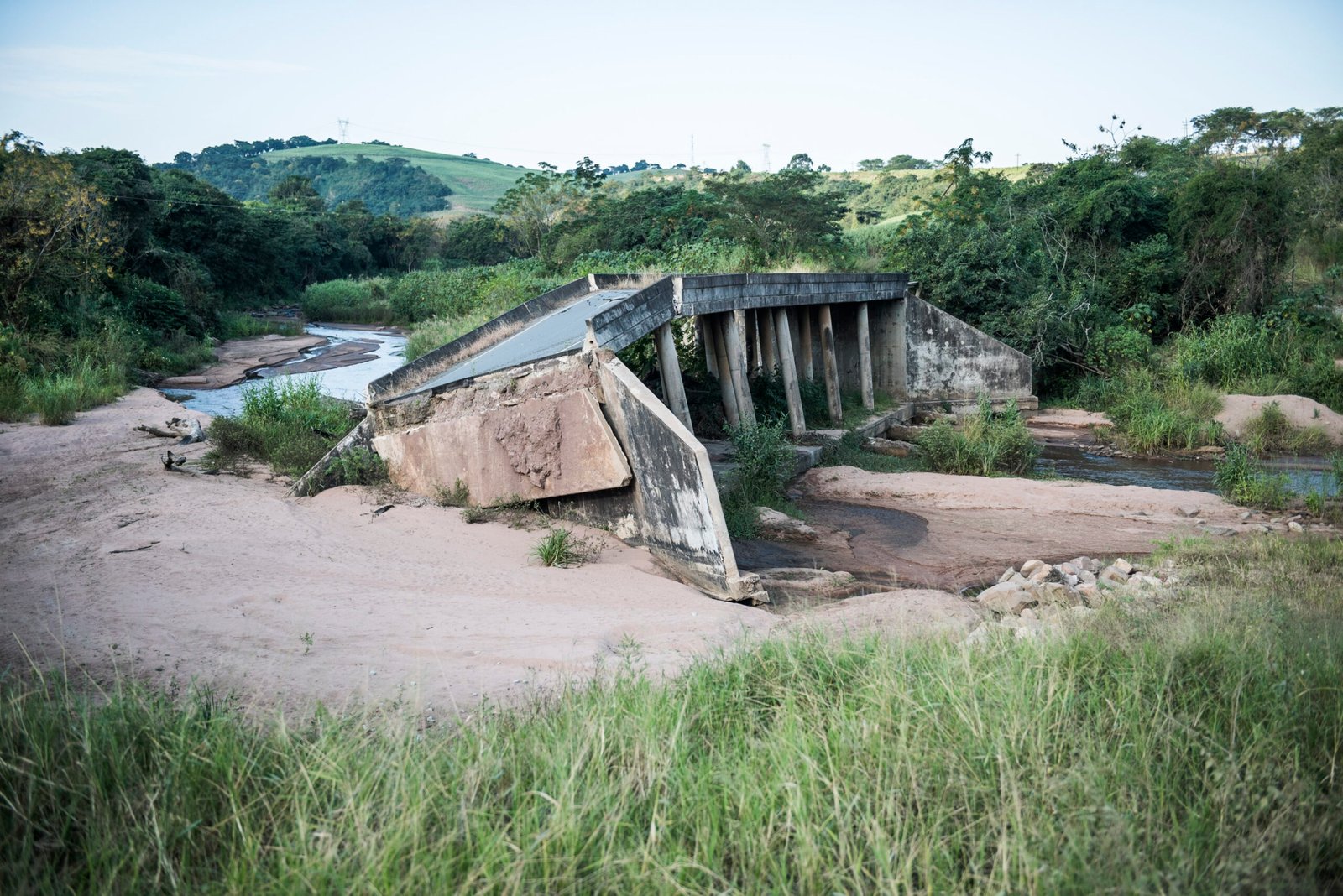
Future-proof: Flood-damaged bridge. Cities that strengthen their finances and build resilience into their investment decisions will be better positioned to mobilize long-term capital. Photo: Delwyn Verasamy
Across the world, and in South Africa as well, cities are on the front lines of climate change risks. Building resilience to climate change requires awareness, planning, institutional capacity, policy coordination, and resources.
In South Africa, municipalities have significant responsibility for infrastructure development, and the question is no longer whether cities need climate change plans, but whether they can implement them.
Alongside technical expertise, the most binding constraint facing cities remains funding. Financing climate-resilient cities will likely prove much more difficult than creating climate action plans.
How have cities been financed?
In many parts of the Global South, urban climate resilience has been financed primarily by public funds. In India, for example, transfers from state governments, centrally sponsored schemes and direct budget allocations account for around 85% to 90% of local government capital expenditures, including climate change investments.
Although self-financed revenues are primarily used to fund operations and maintenance, borrowing remains limited to a few large cities and usually requires higher levels of approval, including explicit or implicit government support.
The pattern is not unique. Cities’ resilience to climate change continues to rely heavily on government budgets and concessional funding, and private commercial capital remains at its limits. While public funding enabled early progress, it is increasingly insufficient given the scale and systemic nature of the climate change challenges facing cities.
The size of the urban climate finance gap
The scale of the climate change challenge highlights why existing financing models are inadequate.
The World Bank estimates that resilient, low-carbon urbanization in low- and middle-income countries will cost between $256 billion (approximately R4 trillion) and $847 billion annually. Reflecting this gap, at the 2024 U20 conference, mayors and city leaders called on governments and development banks to mobilize at least $800 billion annually by 2030 for urban climate action, particularly resilience and adaptation.
Data shows that global urban climate finance has increased, reaching about $831 billion annually in 2021-2022, but remains out of step with needs. This flow is unevenly distributed across the region, heavily biased toward mitigation, and concentrated in developed countries.
As a result, urban climate finance will need to expand several times over the next decade, especially in emerging markets where urban climate risks are increasing.
Why financial models don’t scale
Climate resilience is not a one-time investment, but an ongoing process. Cities must repeatedly upgrade their drainage systems, water networks, transportation routes, power infrastructure, housing, and public spaces, often to standards that need to evolve as climate risks intensify.
At the same time, public finances are under strain as governments face competing demands for health care, social protection, energy transition, and fiscal management. Public budgets are unlikely to expand at the pace needed to respond to escalating urban climate risks.
Therefore, most of the long-term capital needs to be raised from private funds. This will require changes to the regulatory framework governing how cities are financed.
Why is private capital in short supply?
The global financial system is not short on capital. But private capital has largely moved away from climate resilience. The reason for this is not indifference to the consequences of climate change, but rather the difficulty of investing in projects and institutions where returns are uncertain, risks are poorly allocated, and governance frameworks lack predictability.
Adaptation investments are often perceived as unbankable, politically risky, and operationally complex. The real challenge lies less in mobilizing capital and more in making cities investable, which requires governments to empower municipalities and simplify the regulatory frameworks that govern municipal finances and public-private partnerships.
Many cities face structural and capacity constraints in mobilizing finance and designing and implementing complex multi-year programs. The basic prerequisites for accessing commercial finance – audited accounts, reliable financial frameworks, and bankable investment pipelines – are often missing or incomplete.
Borrowing frameworks remain controlled, approvals are slow and capital markets are shallow. Taken together, these factors help explain why private finance remains cautious.
Approaches from South Africa and India
Recent policy signals in several countries suggest a gradual shift towards mobilizing private capital for urban infrastructure. India, for example, aims to make infrastructure investment more bankable through initiatives such as the Cities Challenge Fund and the introduction of risk-sharing mechanisms, but implementation challenges remain at the city level.
Mumbai’s 2021 Climate Action Plan takes an important step in identifying climate-related investments and embedding climate considerations into city planning through climate budgets and dedicated institutional structures.
However, funding continues to follow individual projects rather than being anchored in a resilient system-wide framework, leaving momentum vulnerable to shifts in political and institutional priorities.
Cape Town, by contrast, presents a different approach. Under the R120-billion 10-year infrastructure program, climate resilience is built into every project, including transport, water and electricity. Funding was raised against the city’s balance sheet, not against individual climate change projects. The long-term approach that became mainstream created continuity, reduced reliance on temporary approvals, and proved more attractive for long-term capital.
Across South Africa’s metropolitan municipalities, capital expenditure programs remain largely supported by state transfers and domestically generated funds, with debt financing only a small part of infrastructure.
In this sense, South Africa’s metro represents a hybrid financial model that sits between a highly centralized system and more mature OECD-style balance sheet-driven capital market access. The importance of Cape Town’s model lies in how resilience is built into the city’s overall financial structure, rather than the scale of borrowing.
The City of Johannesburg and eThekwini have similarly accessed municipal debt, development finance and technical assistance from institutions such as the International Finance Corporation, the Southern African Development Bank and other international partners, demonstrating how metropolitan balance sheets can gradually expand access.
Long-term capital will be needed, even if debt only makes up a small portion of Metro’s overall financing.
South Africa has begun to strengthen local government governance and rationalize elements of local government financing and public-private partnership frameworks, building on the move to balance sheet-driven planning and financing. It is also reviewing financial regulations aimed at enabling local authorities to build partnerships and provide funding more effectively.
Metropolitan areas grappling with energy reform and infrastructure delays are facing a changing revenue landscape. Changes in municipal energy procurement and revenue models are beginning to reshape how cities approach investment, revenue stability, and financial risk.
In this context, system-wide resilience built into regular capital planning is more structurally durable and financeable than temporary, project-driven approaches.
Moving from projects to balance sheet-driven pipelines
Private investors do not fund plans or policy announcements. They fund balance sheets that demonstrate sound governance and fiscal discipline.
Cities seeking private capital will need to demonstrate predictable revenues, especially rate stability and reliable revenue collection, spending discipline, reliable debt service capacity, and a clear separation of regulatory and operational roles. We also need to move beyond isolated projects to reliable multi-year investment pipelines where climate resilience is integrated into mainstream capital spending.
More mature capital market cities like Copenhagen are funding flood protection through integrated capital programs, and Paris is issuing green bonds linked to overall infrastructure investments. In India, cities such as Pune and Ahmedabad have shown that improved financial management and clearer capital planning can open up access to debt markets, even though climate borrowing is still in its infancy.
The bridging role of multilateral development banks
As the need for climate finance increases, public finance remains constrained, and private capital becomes cautious, multilateral development banks are playing an important bridge role. These provide long-term capital, technical assistance, and risk mitigation tools to strengthen urban governance frameworks and help cities prepare bankable projects and attract private cofinancing.
Cape Town’s climate-resilient infrastructure program shows how development finance institutions can strengthen financial management and improve access to capital markets. A similar catalytic role can be seen in cities such as Johannesburg and Mexico City.
In South Africa, development partners are helping cities prepare climate-smart infrastructure pipelines and strengthen municipal investment plans, reflecting a growing recognition that bankability starts with organizational capacity and reliable balance sheets, not individual projects.
While multilateral development bank involvement does not replace strong municipal fiscal fundamentals, it can help bridge the gap between public intentions and private capital allocation.
From climate risk to creditworthiness
If the first challenge of urban climate resilience is recognizing the risks, the second is financing the response.
Over the next decade, resilience to climate change will increasingly test the credibility of local governments. Cities that strengthen their balance sheets and embed resilience into mainstream investment decisions will be better placed to mobilize long-term capital.
The move to institutional credit could be decisive for South African cities as they balance climate risks, fiscal pressures and service delivery demands. Because resilient cities are built not only on climate plans, but also on balance sheets.
Rajeev Gopal is an international infrastructure finance expert and former senior country executive at IFC in South Africa.
