


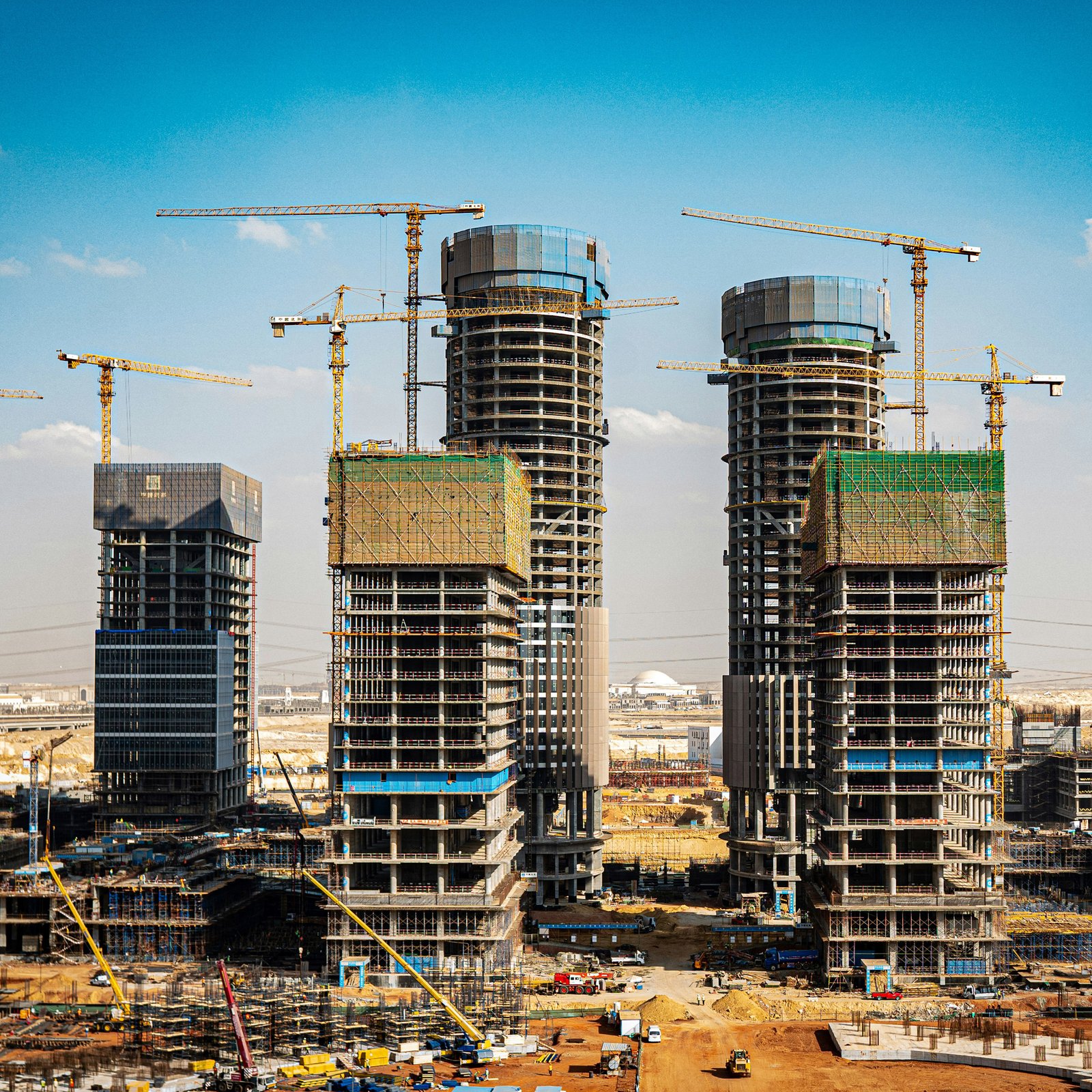
Africa is experiencing a mini-boom in skyscraper construction, with new towers being built in countries such as Egypt, Ethiopia and Ivory Coast. But are they symbols of progress or just vanity projects? Dezeen Editor-in-Chief Amy Frierson investigates.
The Tour F in Abidjan, Ivory Coast will soon become the tallest building on the continent, reaching its height of 421 meters later this year.
This would take the title away from the iconic 394 meter tall tower in Cairo, Egypt. The tower will be completed in 2024, making it Africa’s first completed skyscraper (a title given to buildings over 300 meters tall).
High-rise building gathering pace
This situation is in stark contrast to 10 years ago, when the Carlton Center in Johannesburg, South Africa, was still the only African building to exceed the 200m mark.
At 201 meters high, it was the continent’s tallest tower for 46 years, but looks set to be pushed out of the top 10 in the coming months.
Recent spate of completions include the 250-meter-tall Mohammed VI Tower in Sale, Morocco, completed in 2023, and the 209-meter-tall Commercial Bank of Ethiopia headquarters in Addis Ababa, Ethiopia, completed in 2021. More construction is planned for this year.
Although the rate of development still pales in comparison to North America and Asia, the pace appears to be increasing, which is causing concern.
Somalia-based architect Omar Deegan, co-founder and curator of the first Pan-African Architecture Biennale, is concerned that most of these skyscrapers are being built with little regard for local architectural traditions or lifestyles.
“The rapid increase in skyscraper construction across African cities is raising critical questions about identity, power, climate and the future of cities, especially as many cities grow through imported models rather than locally-based architectural logics,” he told Dezeen.
“I think it’s essential that we figure out both the opportunities and the risks this presents,” he said. “And to ask whether verticality can respond meaningfully to the African context, rather than simply replicating a global template.”

10 skyscrapers scheduled to be completed in 2026
Deegan isn’t opposed to skyscrapers being built in African cities, but he would like to see models that reflect Africa’s cultural identity.
“I think we’ve lost the opportunity to look at skyscrapers as a way to identify a nation,” he says. “I’d like to see a skyscraper in Morocco or a skyscraper in Nigeria.”
But what is fueling this mini-boom, and can we expect it to continue?
Jason M. Barr, an economics professor at Rutgers University-Newark, said the data shows a link between skyscraper construction and economic growth in Africa.
“Iconic buildings benefit African cities, but the economy must function.”
According to statistics from the Vertical Urban Planning Council, Africa’s two largest economies, South Africa and Egypt, account for about 75 percent of all buildings over 30 storeys on the continent.
Egypt also has more skyscrapers under construction in both Cairo and the country’s new capital than the rest of Africa combined.
“Countries generally don’t build skyscrapers unless they have the ‘economic ducks’ in place, because they are expensive to build and operate,” explains Barr, author of Cities in the Sky: The Quest to Build the World’s Tallest Skyscrapers.
“If you look at the usage breakdown of all buildings over 30 storeys in Africa, most are office, residential or mixed-use buildings, meeting the economic needs of high-rise buildings,” he told Dezeen.

Barr argues that African cities can benefit from the power of skyscrapers as a “confidence booster”. He said few appear to be “white elephants” created as status symbols rather than to meet real needs and demands.
“Iconic buildings can benefit African cities, but the underlying economics of these buildings need to work: the revenue paid by the occupiers needs to cover construction and operating costs,” he said.
“Given the history of economic and political problems in Africa, we tend to associate Africa’s towers with what emerges from its environment,” he added. “But rather, its towering towers seem to reflect the desire of these countries to participate in the international community.”
Nigerian architect Tosin Osinowo is more skeptical. She feels there is a clear difference between skyscrapers built in Egypt and skyscrapers built in other African cities.
“Skyscrapers are ultimately a symbol of progress,” she says. “African countries are starting to think in that capacity, not because their economies are strong enough to achieve it, but because they want to present a narrative.”
“Is this what Africa needs? I don’t think so.”
As Osinowo points out, Africa accounts for just under 3% of global GDP and does not have the same land availability problems as other regions such as Europe and the Middle East.
This has led her to question whether developments like Eko Atlantic City, the huge new high-rise district being built in her hometown of Lagos, are appropriate. She believes density can be achieved with buildings that are more African in scale and approach.
“The world has a story about what we consider progress, and anything that deviates from that is not considered progressive,” she said.
“But there are many ways in which these problems can be solved, so it is not worth justifying this symbol. And is this symbol what the continent needs? I don’t think so.”
Osinowo cites the lack of steel in Africa as one reason why skyscrapers have little meaning in Africa.

Zaha Hadid Architects unveils Ethiopia’s Bishoftu International Airport
Because it’s expensive to import, local contractors don’t have the necessary construction expertise. Many of the skyscrapers currently under construction are being built by Chinese companies.
Electricity is another issue. Unlike North Africa, cities in West and Sub-Saharan Africa regularly experience power outages.
“Tall buildings require certain infrastructure and equipment that we don’t have as standard,” Osinowo said.
“When you introduce a typology that requires them, it’s a whole different ball game. What happens if you’re in an elevator and the power goes out?”
But Hans Degraeuwe, a Belgian architect and construction consultant who has worked in Africa for more than 15 years and lives part-time in Lagos, argues that high-rise buildings may be needed as cities develop further.

“Unlike the urban sprawl that happened in America, Africa needs to verticalize because it can’t afford to simply build road infrastructure, power infrastructure and data infrastructure,” he told Dezeen.
With support from a sovereign wealth fund, Degrauwe is currently developing a customizable modular high-rise model, with plans to roll out different versions at 24 prefabricated test sites across Africa, including a prefabricated one in Lagos.
He believes that prefabrication technology has the potential to provide an answer not only to expertise in building skyscrapers, but also to problems related to the lack of public facilities where the buildings themselves provide basic infrastructure for entire neighborhoods.
“The skyscraper we want is not just a five-star hotel,” he said. “We want to make a hotel that combines a hostel, a clinic, and a water treatment plant.”
“I’m trying to create a vertical community that combines a variety of features, including affordable housing.”
It remains to be seen whether this low-lying continent will be able to adapt the model of vertical urbanism to its needs. Either way, the skyscraper trend shows no signs of slowing down just yet.
Featured photo by Youssef Abdelwahab via Unsplash.
More about Dezeen
For more interviews, opinions and features on Dezeen, subscribe to Dezeen In Depth. Sent on the last Friday of every month, this newsletter lets you read the design and architecture stories behind the headlines in one place.
