


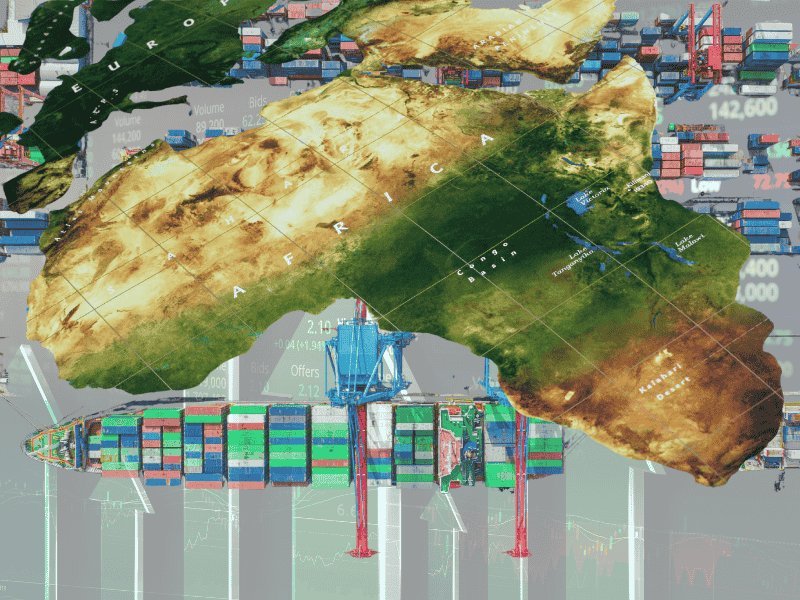
African trade has been at the center of discussion, with China recently announcing its decision to grant zero tariffs on goods from 53 African countries. The move comes as competing world powers strengthen trade dynamics with the continent, targeting mineral security, diversification of supply chains and access to high-demand goods. For Africa, the economic war between China, the US and Europe raises important questions about whether African countries can convert tariff concessions into value-added production.
Preferential trade and China’s zero tariff policy
Starting May 1, 2026, China will implement zero tariff measures for all 53 African countries, excluding Eswatini. The policy is based on zero-tariff access for 33 least developed countries (LDCs), which came into effect in 2024. China’s imports from African LDCs increased by 15.2% year-on-year to $21.4 billion by March 2025. For many years, China-Africa trade amounted to $295 billion, dwarfed by the $8 billion trade between the United States and Africa.
The latest zero-tariff policy is expected to not only support new trade flows between China and Africa, but also strengthen the Asian country’s position as Africa’s preferred trading partner. Notably, Beijing’s unilateral market access approach does not require reciprocal concessions from African partners, positioning China as the continent’s largest bilateral trading partner while deepening control over the entire value chain, from mining to processing and logistics. However, China is not the only country vying for preferential treatment in African trade.
AGOA expansion and the dynamics of US-Africa trade
On February 3, US President Donald Trump signed a bill reauthorizing the African Growth and Opportunity Act (AGOA) through the end of 2026. The program, which provides eligible African countries with duty-free access to the U.S. market, expired on September 30, 2025, and the extension gave eligible African exporters five months to regain access.
Angola and Senegal are expected to maintain strong export performance thanks to their oil and mineral sectors, although increases will be limited by overlapping US tariffs of 10-30% due in 2025. A one-year extension of AGOA provides temporary relief but constrains long-term investment plans. The extension aims to encourage local processing capacity through technical assistance programs, but conditions remain on Washington’s commitment to African manufacturing.
EU Realignment: Global Gateways and Economic Partnerships
Europe finds itself navigating increasing U.S.-China competition while trying to maintain commercial relevance in Africa. The EU’s international partnership initiative, Global Gateway, will mobilize €150 billion for Africa by 2027, with 138 flagship projects adopted between 2023 and 2025. The EU also announced a €4.7 billion investment package for South Africa in 2025 to support processing of critical raw materials and green hydrogen production.
Alongside its infrastructure investments, the EU maintains economic partnership agreements with several African regions, offering mutual market access that differs from China’s unilateral approach or AGOA’s preferential model. The EU’s strategy combines trade access with infrastructure financing, positioning Europe as a partner in industrial development rather than a complete buyer. However, China-Africa trade is nearly 37 times larger than AGOA-related trade, and the challenge for Europe is to maintain strategic relevance as China and the US develop competing frameworks.
Turn competition into industrial capability
African producers are taking advantage of this competition to extract promise beyond market access.
“It’s not about the supply of raw materials, it’s about building value,” said Louis Watum Kabamba, Democratic Republic of the Congo’s Minister of Mines, at a recent event in Cape Town. The Democratic Republic of the Congo, which has an estimated $24 trillion in untapped mineral resources, partnered with the United States to develop local mineral processing infrastructure in late 2025, demonstrating how geopolitical rivalry can create bargaining power.
Aiming to increase added value, Angola aims to increase refining capacity to more than 400,000 barrels per day through the Cabinda, Soyo and Lobito refineries, starting in 2025, 2026 and 2027, respectively. Ghana’s Gold Coast refinery is being expanded to 1,000 kg per day, and Mali’s 200 tonne per year gold refinery is expected to generate $140 billion a year in value-added gold exports, up from $1.4 billion in 2024. Senegal’s SAR 2.0 program is building a second smelter costing between $2 billion and $5 billion, with a target of 5 million tons per year, and financing discussions are underway with investors from China, Turkey, Turkey and other countries. South Korea.
These developments highlight how strategic producers are using this moment to negotiate from a position of strength. Africa no longer needs to fight for access to world markets. China, the United States and Europe have confirmed that they will fight for access to Africa through competing trade policies. The question is whether African countries can take advantage of this competition to further strengthen domestic processing capacity and continue to capture value beyond the extraction of raw materials.
